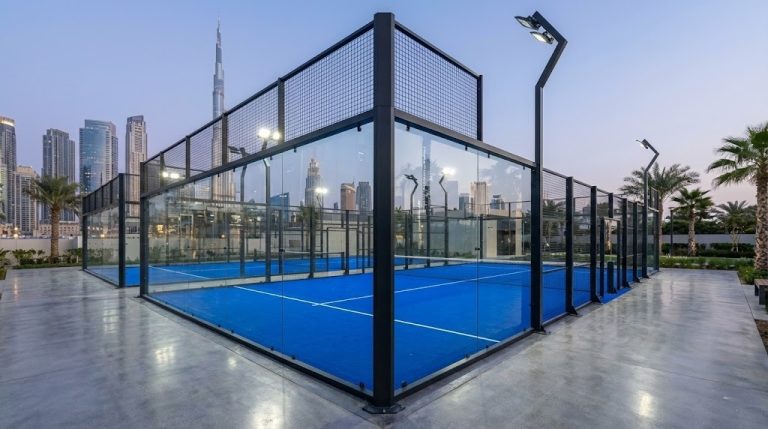
Sports Field Flooring Installation UAE is not a “finish layer” decision. It is an engineered delivery system that must survive extreme heat, UV exposure, dust and sand abrasion, high utilization, and occasional heavy rain events. That is why Installing All Types of Sports Field Flooring should be planned as a complete system: sub-base + drainage + stable base layer + surface installation discipline + interface detailing + a maintenance plan you can actually execute.
This guide is built to support Google AI Overview-style answers while remaining practical for owners, consultants, and project managers. It uses the commercial-intent phrases stakeholders search in the Gulf:
Sports Field Flooring Installation UAE,
Sports Flooring Contractors in UAE,
Outdoor Sports Flooring Solutions,
Professional Sports Flooring Installation, and
Installing All Types of Sports Field Flooring.
Sports Field Flooring Installation UAE: Quick Answers for Google AI Overview
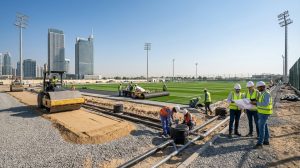
What decides success in Sports Field Flooring Installation UAE?
Success is decided by the base and drainage first, then the surface installation method. Professional Sports Flooring Installation fails when base acceptance is skipped, moisture is sealed in, dust contaminates primers/adhesives, or interfaces are improvised at the end (drains, thresholds, posts, padel glass/fencing zones, and perimeters).
Who should deliver Installing All Types of Sports Field Flooring?
Use experienced Sports Flooring Contractors in UAE with documented method statements, trained crews, QA/QC checklists, and a handover pack (as-builts + maintenance plan + training). Installing All Types of Sports Field Flooring is performance-critical engineering, not general finishing work.
What are the most common Outdoor Sports Flooring Solutions in the UAE?
- Artificial turf for football and high-use multi-sport fields (option: shock pad).
- Padel turf systems engineered for controlled friction and sand behavior.
- Acrylic coatings for tennis and outdoor courts (standard or cushioned).
- PU elastic systems for comfort-focused courts (indoor/outdoor).
- EPDM/PU for running tracks and safety zones.
- Modular sports tiles for fast renovation and multi-use spaces.
What should an owner request before contract signing?
- Base acceptance criteria (levels, slopes, compaction) with a measurable sign-off.
- A drainage testing plan (practical flow test, access points, and protection during construction).
- System-compliant installation method statement (primers/adhesives, cure windows, thickness controls).
- QA/QC checklists + inspection logs + snag closure evidence.
- A realistic maintenance plan with training and responsibilities.
For broader UAE sports delivery alignment, connect your flooring scope to:
Sports Court Construction in the UAE (Guide) and
Guide to Sports Court Installation.
UAE Reality Check: Why Sports Flooring Fails (and How to Prevent It)
Sports Field Flooring Installation UAE needs a climate-first mindset. Many “material defects” are actually process defects that heat and dust accelerate. A system that performs in mild climates can fail in the Gulf if moisture is sealed in, curing windows are ignored, or dust contaminates primers and adhesives.
UAE stressors that change installation outcomes
- Heat + UV: shortens working time, increases thermal movement, stresses edges and seams.
- Dust + sand abrasion: contaminates prepared substrates and accelerates wear if cleaning is inconsistent.
- Heavy rain events: expose slope errors and blocked drainage immediately.
- High utilization: schools and communities exceed “light-use” assumptions quickly.
- Mixed site logistics: other trades and landscaping can block drains and contaminate surfaces during curing.
Prevention that works on real sites
- Document base acceptance (levels, slopes, compaction) before surface works begin.
- Test drainage routes and keep them protected from debris throughout construction.
- Control substrate cleanliness (dust management) and follow system-approved primers/adhesives.
- Detail interfaces early: drains, thresholds, posts, padel glass/fencing zones, and perimeters.
- Plan maintenance and operational controls from day one (tools, schedule, responsibilities).
If you want a full facility lens beyond flooring, reference:
Sports Infrastructure Construction and
Expert Sports Field Construction.
What “Sports Field Flooring” Really Includes (The Full System)
Installing All Types of Sports Field Flooring means delivering an engineered system that starts below the surface. Owners often focus on the visible layer, but performance depends on what is beneath it and how it is installed.
| System Layer | What it does | Typical failures if ignored | Acceptance check (practical) |
|---|---|---|---|
| Survey + setting-out | Locks dimensions, levels, and falls | Misalignment, rework, unsafe run-offs | Setting-out records + drawings |
| Formation + grading | Creates stable platform and falls | Unevenness, settlement | Laser level survey log |
| Sub-base (engineered aggregates) | Supports loads, keeps levels stable | Soft spots, deformation, poor drainage | Compaction records + spot checks |
| Drainage (surface + subsurface) | Moves water away fast | Pooling, algae growth, slip risk | Drainage flow test + access check |
| Base course (asphalt/concrete as needed) | Stable substrate for coatings | Reflective cracking, delamination | Flatness + cure + cleanliness |
| Surface system | Traction and sport performance | Premature wear, unsafe play | Surface inspection + snag list |
| Interfaces + accessories | Edges, drains, posts, fencing/glass | Trip hazards, tearing, water traps | Interface inspection + sign-off |
| Maintenance plan + training | Protects performance and warranty | Rapid deterioration | Training record + schedule |
This system view is the foundation of Professional Sports Flooring Installation and the clearest way to reduce rework and lifecycle cost.
How to Choose the Right Flooring System Fast (Without Guesswork)
Outdoor Sports Flooring Solutions should be selected using performance priorities and maintenance reality, not brochures. The fastest “good decision” is aligning sport intent, site exposure, and operating model.
Sports Field Flooring Installation UAE: the 10-question decision checklist
- Which sport(s) and level? Community play differs from academy/pro requirements.
- Indoor or outdoor exposure? UV and heat influence coatings and adhesives.
- Daily hours of use? Higher utilization needs stricter maintenance discipline.
- Single sport or multi-sport? Multi-sport is always a performance trade-off.
- Drainage reality? Flat sites and limited outfall require stronger engineering.
- Base type? Asphalt/concrete vs engineered base changes the system options.
- Slip and safety priority? Texture and shock layers may be critical.
- Downtime tolerance? Some systems require recoating or periodic refresh.
- Maintenance capability? Choose what your team can do weekly.
- Lifecycle target? Warranty compliance, performance stability, and repairability matter.
Selection matrix: match the system to your priorities
| Priority | Best-fit systems | Why it fits | Watch-outs |
|---|---|---|---|
| Highest utilization outdoor field | Artificial turf (option: shock pad) | Stable scheduling and playability | Drainage, seams, infill management |
| Padel consistency and aesthetics | Padel turf system | Controlled friction and sand stability | Flatness + edge interfaces with glass/fencing |
| Clean tennis performance | Acrylic (standard or cushioned) | Predictable ball response, recoatable | Base cracking and cure discipline |
| Comfort-focused multi-purpose court | PU elastic sports surface | Better cushioning and traction | Moisture + bonding + curing control |
| Fast renovation / modular approach | Modular sports tiles | Speed and replaceability | Base flatness + perimeter detailing |
| Track + safety zones | EPDM/PU track system | Impact performance and durability | Thickness control + granule bonding |
For UAE court project scoping, link this flooring guide to:
Sports Court Construction in the UAE and
Sports Field Construction UAE.
All Major Flooring Types: Best Use + Risks + Controls
Installing All Types of Sports Field Flooring becomes predictable when each system is understood by best use, sensitivity, and required process controls.
1) Artificial Turf (Football + High-Use Multi-sport)
Artificial turf is widely used in the UAE because it supports consistent scheduling and reduces downtime. The system includes a prepared base, optional shock pad, turf rolls, seams, infill, and line inlays. Professional Sports Flooring Installation for turf is won on drainage performance, seam integrity, and infill stability.
- Best for: outdoor football fields, schools, community fields, training zones.
- Risks: pooling from slope errors, seam opening, traction inconsistency from uneven infill.
- Controls: base acceptance + drainage test, seam method log, staged infill and brushing records.
2) Padel Turf Systems (Padel Courts)
Padel flooring is a specialized turf system designed for controlled friction and stable sand behavior. The flooring must integrate with padel glass and fencing zones, thresholds, and drainage. This is where choosing experienced Sports Flooring Contractors in UAE matters, because edge details and flatness control decide performance and aesthetics.
- Best for: clubs, schools, hotels, private developments.
- Risks: uneven sand distribution, edge lifting, inconsistent bounce in high-wear zones.
- Controls: strict flatness checks, controlled sand installation, disciplined edge interfaces.
Related internal references:
Padel Court Installation UAE,
Padel Court Fencing Installation,
Padel Court Construction Cost UAE.
3) Acrylic Court Systems (Tennis + Outdoor Courts)
Acrylic is a multi-layer coating system installed over asphalt or concrete. It is popular because it offers clean aesthetics, predictable ball response, and refresh via recoating. For Sports Field Flooring Installation UAE, acrylic success is base-and-prep discipline: curing, cleanliness, priming, layer timing, and line accuracy.
- Best for: tennis, outdoor basketball/multi-purpose courts, schools.
- Risks: reflective cracking, delamination from poor prep, inconsistent texture from rushed application.
- Controls: substrate prep checklist, primer verification, cure window logs, line marking QA.
4) PU Elastic Sports Flooring (Outdoor/Indoor)
PU systems are elastic sports surfaces selected for improved comfort and traction. They are sensitive to moisture and curing. Professional Sports Flooring Installation using PU requires disciplined preparation, moisture management, and thickness control to avoid blistering, soft spots, or delamination.
- Best for: comfort-focused courts, premium community courts, indoor/outdoor multi-purpose halls.
- Risks: blistering from moisture, soft spots, inconsistent thickness and texture.
- Controls: moisture management plan, thickness spot checks, cure logs, system-approved primers.
5) EPDM/PU Track Systems (Running Tracks + Safety Zones)
EPDM/PU systems are used for tracks and safety areas because they can deliver impact performance and durability when specified and installed correctly. In the UAE, turning zones and high-wear areas demand reinforcement and strict thickness control.
- Best for: athletics tracks, school running tracks, safety zones.
- Risks: granule loss, uneven thickness, early wear in turning lanes.
- Controls: uniform mixing/application, cure discipline, targeted reinforcement in wear zones.
6) Modular Sports Tiles (Fast Build + Renovation)
Modular tiles work when speed and replaceability matter. They still require base flatness and correct edge detailing to prevent localized lifting, movement noise, and water traps.
- Best for: schools, renovation projects, fast multi-use courts.
- Risks: edge lift, movement noise, water traps if slopes are wrong.
- Controls: base flatness acceptance, drainage reality check, perimeter restraint detailing.
Single-view performance comparison table (owners + consultants)
| System | Best-fit spaces | Performance strengths | Primary sensitivity | Maintenance reality |
|---|---|---|---|---|
| Artificial turf | Football, multi-sport fields | High utilization scheduling | Drainage, seams, infill | Brushing + cleaning is mandatory |
| Padel turf | Padel courts | Controlled friction + stable play | Flatness, sand stability | Sand distribution management |
| Acrylic | Tennis, outdoor courts | Clean finish, recoatable | Base cracks, cure windows | Cleaning + periodic recoating |
| PU elastic | Comfort-focused courts | Cushioning and traction | Moisture and bonding | Cleaning + local repairs |
| EPDM/PU track | Tracks, safety zones | Impact performance | Thickness and bonding | Cleaning + targeted wear repairs |
| Modular tiles | Fast multi-use courts | Speed + replaceability | Base flatness and edges | Easy replacements if stocked |
For a wider infrastructure lens beyond surfaces, see:
Sports Infrastructure Construction and
Expert Sports Field Construction.
Installing All Types of Sports Field Flooring: The 23-Step Installation Workflow
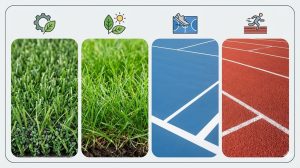
This workflow is designed so owners and consultants can audit the project and reduce rework risk. It is also the practical backbone of Professional Sports Flooring Installation in the UAE.
Step-by-step (23 steps owners can audit)
- Define sport intent and utilization: single sport vs multi-sport, expected daily use, level of play.
- Lock layout and line hierarchy: dimensions, run-offs, safety zones, line priority for multi-use.
- Confirm site constraints: access routes, utilities, soil behavior, and drainage outfall.
- Agree drainage concept: falls, channels, inspection points, outfall plan.
- Select the system specification: surface type, shock layers, accessories aligned to operation.
- Approve method statement: sequence, materials, cure windows, control points.
- Mobilize logistics: storage, shading, dust control, safe access planning.
- Set site protection rules: keep drains clear, protect base from contamination, control foot traffic.
- Prepare formation: remove unsuitable material and establish initial grading.
- Install separation/geotextile layers (if required): prevent contamination and migration.
- Build sub-base in controlled lifts: engineered aggregates with compaction control.
- Set final falls and flatness: laser levels, recorded survey, corrective actions if needed.
- Install drainage components: channels/pipes/access points; protect from debris.
- Construct base course (as required): asphalt/concrete with correct cure and preparation.
- Acceptance Gate 1 (non-negotiable): verify levels, slopes, compaction, and drainage flow.
- Substrate cleaning protocol: remove dust, confirm dryness/cleanliness before primers/adhesives.
- Surface installation begins: system-compliant methods, trained crew, controlled working windows.
- Installation control log: record seams, thickness, primer/adhesive batches, cure times.
- Detail interfaces and edges: drains, thresholds, posts, fencing/glass zones, restraints.
- Line marking and graphics: accuracy checks and clean edges; measure before paint.
- Acceptance Gate 2: finish inspection, snag list, safety walk-through.
- Commissioning checks: practical tests relevant to the system and intended sport use.
- Handover and training: as-builts, maintenance plan, tools guidance, responsibility mapping.
Critical installation controls by surface (what to verify on site)
| Surface type | Critical control | On-site verification | Failure if ignored |
|---|---|---|---|
| Artificial turf | Seam integrity + infill stability | Seam log, staged infill depth checks, brushing records | Seam opening, traction inconsistency |
| Padel turf | Flatness + sand distribution | Flatness checks, sand depth mapping, edge interface inspection | Inconsistent bounce, edge lift |
| Acrylic | Substrate prep + cure windows | Prep checklist, primer verification, layer timing records | Delamination, reflective cracks |
| PU elastic | Moisture + bonding + thickness | Moisture plan, thickness spot checks, cure logs | Blistering, soft spots |
| EPDM/PU track | Uniform granule bonding | Texture review, localized bonding inspection | Granule loss, uneven lane feel |
| Modular tiles | Base flatness + edge detailing | Perimeter inspection, movement/noise checks | Edge lift, instability noise |
For sequencing and scope coordination, connect to:
Sports Court Construction in the UAE (Guide) and
Sports Court Construction in the UAE.
QA/QC, Testing, and Handover Checklist (Owner-Ready)
Sports Field Flooring Installation UAE must be supported by evidence. Quality is measurable acceptance criteria and documentation that protects both the owner and the contractor. This is also what separates general installers from true Sports Flooring Contractors in UAE.
Minimum QA/QC checks to request in the UAE
- Levels and slopes: documented laser-level readings before surface installation.
- Drainage verification: practical flow test + confirmation of drain access.
- Surface finish acceptance: seams, edges, thickness (as relevant), and line accuracy.
- Interface inspection: drains, thresholds, posts, padel glass/fencing zones, perimeters.
- Snag closure evidence: photo log + sign-off per item.
- Maintenance training: schedule, tools, do’s and don’ts, responsibility mapping.
Handover deliverables (what “professional” includes)
| Deliverable | What it contains | Why it matters |
|---|---|---|
| As-built package | Key levels, drainage routes, interface details | Future upgrades, repairs, accountability |
| System data and references | Datasheets, components, approved materials | Warranty clarity and correct replacements |
| QA/QC checklists | Base acceptance, surface inspection, snag closure | Transparent acceptance + dispute reduction |
| Maintenance plan + training record | Weekly/monthly schedule, tools, methods | Protects performance and lifecycle value |
External authority references (governance + standards):
FIFA,
World Athletics,
FIBA,
ITF,
ASTM,
ISO.
Maintenance That Protects Performance and Warranty
Professional Sports Flooring Installation does not end on handover day. Surface performance remains stable only when maintenance is consistent. The best strategy is selecting Outdoor Sports Flooring Solutions your facility team can maintain weekly without fail.
Practical maintenance schedule (use this as your operating SOP)
| Surface | Weekly essentials | Monthly essentials | What it prevents |
|---|---|---|---|
| Artificial turf | Debris removal + brushing high-use zones | Deep brush, infill leveling, seam checks | Compaction, seam stress, traction loss |
| Padel turf | Surface cleaning + localized sand grooming | Sand depth mapping and redistribution | Inconsistent bounce and wear patterns |
| Acrylic courts | Cleaning and dust removal | Inspect cracks/joints, plan recoating cycles | Water infiltration and slip risk |
| PU elastic | Cleaning + visual checks for wear zones | Local repairs for worn spots | Wear spread and traction decline |
| EPDM/PU track | Cleaning + debris control | Targeted repair in turning/heavy-use zones | Granule loss spread and safety decline |
| Modular tiles | Cleaning + check movement zones | Replace damaged tiles, inspect edges | Edge lift and localized instability |
Maintenance mistakes that shorten lifecycle
- Using harsh chemicals or unapproved tools that degrade coatings or fibers.
- Ignoring early defects (small issues grow fast under heat and traffic).
- Blocking drainage routes with landscaping, storage, or event equipment.
- Allowing heavy non-sport loads without protective planning.
- Skipping regular brushing/sand management on turf systems.
If you want a full build-to-operate approach, reference:
Guide to Sports Court Installation.
Cost Drivers + Typical Timeline in the UAE
Sports Field Flooring Installation UAE should be procured as a complete system scope, not “surface-only.” The same surface can be installed on a strong base or a weak base—two completely different outcomes and lifecycle costs.
Primary cost drivers (what actually moves the budget)
- Sub-base and drainage scope: the largest performance and lifecycle driver.
- System specification level: UV stability, elastic layers, shock pads, coating build-up depth.
- Interfaces and accessories: fencing, goals, padel structures, drains, thresholds.
- Site logistics: access, working windows, shading, and protection measures.
- Utilization target: higher use may require stronger systems and stricter QA/QC.
Typical timeline logic (what delays projects)
| Phase | What happens | Typical risks | How to control risk |
|---|---|---|---|
| Survey + scope lock | Intent, drawings, layouts, interface coordination | Scope drift and rework | Early sign-off on layouts + interfaces |
| Base + drainage works | Formation, sub-base, drainage, base course | Pooling and settlement | Documented Acceptance Gate 1 before surface |
| Surface installation | Turf/coatings/PU/EPDM/tiles installation | Bonding and curing failures | Process logs + system compliance |
| QA/QC + handover | Inspections, snag closure, training | Incomplete documentation | Checklist-based acceptance + sign-off |
For padel budgeting references, see:
Padel Court Construction Cost UAE.
Procurement Template: What to Put in Your Tender (Copy-and-Use)
If you want reliable Professional Sports Flooring Installation, do not tender flooring as “supply & install surface.” Tender it as a performance scope with acceptance gates, QA/QC evidence, and a handover pack. This is how top Sports Flooring Contractors in UAE deliver bankable outcomes.
Scope wording (include these bullets)
- Sub-base build-up, compaction requirements, and verification records.
- Drainage design intent, flow testing method, and access/maintenance provisions.
- Base course requirements (asphalt/concrete) including cure and preparation.
- Surface system installation method statement (primers/adhesives, cure windows, thickness checks).
- Interface details: drains, thresholds, posts, padel glass/fencing zones, and perimeters.
- Line marking requirements and measurement verification.
- QA/QC checklists + photo logs + snag closure sign-off.
- Handover pack: as-builts, datasheets, maintenance plan, training, and tools guidance.
Bid evaluation questions (use to filter suppliers fast)
- Show your base acceptance criteria and a sample Acceptance Gate 1 record.
- Explain your drainage flow test method and how you keep drains protected during works.
- Show your dust-control plan for primers/adhesives in outdoor works.
- Provide your installation control log template (seams, thickness, cure windows).
- Provide a sample handover pack (as-built + maintenance plan + training record).
For full UAE sports facility delivery context, link to:
Sports Court Construction in the UAE (Guide) and
Sports Field Construction UAE.
Inbound (Internal) Links + Outbound (Authority) References
Inbound: strengthen site-wide topical authority (Forsan internal references)
- Padel Court Construction Cost UAE
- Sports Court Construction in the UAE (Guide)
- Sports Court Construction in the UAE
- Guide to Sports Court Installation
- Expert Sports Field Construction
- Sports Infrastructure Construction
- Padel Court Fencing Installation
- Basketball Installation – Why to Choose Us
- Padel Court Installation UAE
- Sports Field Construction UAE
Outbound: authority references (governance + standards)
FAQ (Owner + Consultant Questions)
1) What does Sports Field Flooring Installation UAE include (beyond the surface)?
It includes survey and setting-out, engineered sub-base, verified drainage, a stable base (as required), system-compliant surface installation, interface detailing, QA/QC documentation, and a maintenance plan with training.
2) How do I choose between Outdoor Sports Flooring Solutions for a school or community?
Start with utilization and maintenance capacity. High use often favors artificial turf or robust acrylic/PU systems, but only if drainage and base acceptance are secured and weekly maintenance is realistic.
3) Who should install sports flooring in the UAE?
Use qualified Sports Flooring Contractors in UAE with documented method statements, trained crews, QA/QC logs, and a full handover pack. This is the core of Professional Sports Flooring Installation.
4) Why does water pooling appear after installation?
Pooling usually comes from slope errors, uneven compaction, or blocked drainage routes. Prevent it with documented level control and drainage flow testing before surface installation starts.
5) Acrylic vs PU: which is better for outdoor courts?
Acrylic is practical, clean, and recoatable. PU is often chosen for comfort and elasticity. Both demand disciplined substrate preparation and correct sequencing to avoid delamination or soft spots.
6) What is the biggest risk when Installing All Types of Sports Field Flooring for padel?
Flatness and edge detailing. Padel performance and aesthetics depend on strict base tolerance, controlled sand behavior, and disciplined interfaces with glass/fencing zones.
7) What should be included in the handover package?
As-built documentation, system datasheets, QA/QC checklists, snag closure evidence, and a maintenance plan with training. This protects warranty and long-term performance.
8) How many internal links should a flooring article include?
Typically 8–15 context-relevant internal links is a healthy range. The goal is navigation + stronger topical authority across your sports construction cluster.
9) What does “professional” look like in Professional Sports Flooring Installation?
Clear acceptance gates (base + drainage), controlled installation logs (seams/thickness/cure), documented QA/QC, and practical handover training—so the facility can maintain performance.
10) Why choose Forsan Al-Amal AlSarea?
Because Sports Field Flooring Installation UAE is delivered as a complete system: base, drainage, surface, interfaces, QA/QC, and handover—aligned with real UAE climate and utilization.
For deeper scope alignment, see Guide to Sports Court Installation.