Horse Stable Flooring UAE – Engineering & Practical Guide to Choosing and Installing the Best System
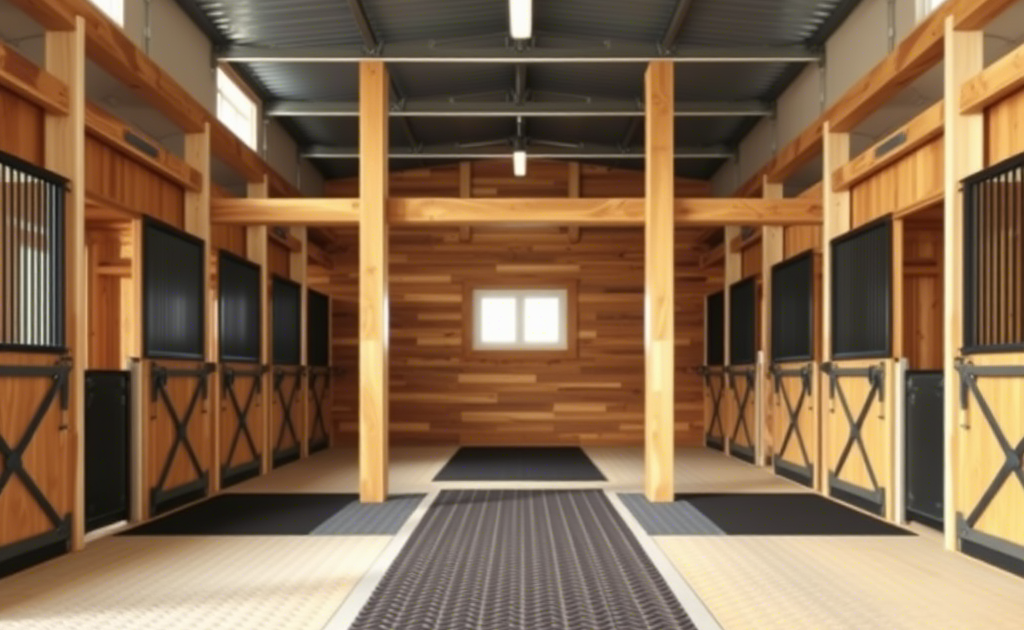
When you design a professional horse stable in the UAE, the first things that usually come to mind are ventilation, stall size, and layout. But in reality, one of the most critical components is the
horse stable flooring. The floor is the surface your horse stands, turns, lies down, and walks on all day. Any mistake in choosing or installing the flooring can lead to joint and hoof injuries,
cleaning difficulties, strong odors, and ongoing operational costs.
On the other hand, choosing the best horse stable flooring in UAE and installing it with the correct engineering details makes the stable more comfortable for the horses, easier to manage for staff,
and more valuable as a long-term investment for the owner. This is where Forsan Al Amal Alsarea comes in as one of the specialized
horse stable flooring contractors offering rubber, composite and sports flooring systems, with practical experience in
horse stable flooring installation UAE across different climates and locations in the country.
This guide is not just a marketing article; it is a practical reference you can rely on at every stage of your project: from understanding the basic needs of the horse, to comparing different
horse stable flooring systems, all the way to receiving a fully operational stable and keeping it in good condition through proper maintenance.
What Is Horse Stable Flooring and Why Is It So Critical?
Horses spend most of their day standing or lying down in the stable, which means the quality of the horse stable flooring has a direct impact on:
- Joint and tendon health – Floors that are too hard or have no resilience put continuous pressure on the horse’s joints (fetlocks, hocks, back), increasing the risk of inflammation and fatigue.
- Hoof health – Slippery or uneven floors, or surfaces with gaps, can cause slipping or hoof trapping, leading to twists, sprains, or more serious injuries.
- Stable hygiene and odors – Flooring systems that do not drain urine properly, or trap liquids underneath, quickly develop strong smells and promote bacterial and fungal growth.
- Labour and cleaning cost – Well-designed stable flooring reduces cleaning time and the amount of bedding required, which significantly lowers monthly operating costs.
Many international guidelines and resources – such as recommendations from the
British Horse Society
and scientific articles on
The Horse – confirm that flooring is just as important as stall size or ventilation. For that reason, any serious
horse stable flooring installation UAE project should start with a technical assessment of the flooring system, not treat it as an afterthought.
Key Factors to Study Before Choosing Horse Stable Flooring
Before diving into material types and cost, it is essential to ask yourself and your team a few questions that will define the right direction for your project:
- Type of stable and horses
Are the horses used for racing, show jumping, tourism/trekking, or beginner training? High-value performance horses usually require higher levels of comfort and protection through
high-density rubber horse stable flooring, while a basic training stable with lower intensity might be able to rely on a high-quality concrete base with thick bedding. - Number of stalls and daily usage intensity
A small 10-stall private barn is very different from a 50-horse training center. Usage intensity directly affects the expected lifespan of the floor and the maintenance plan. - Bedding system
Will you use wood shavings, straw, pellet bedding, or integrated rubber mattress systems? The relationship between bedding and the chosen
horse stable flooring must be designed as one complete system, not as separate decisions. - Cleaning method and level of automation
Will the stable be cleaned manually by staff with simple tools, or will you use pressure washers and semi-automated equipment? Some systems tolerate both, while others can be damaged by heavy
water use or aggressive chemicals. - Available budget and required service life
In many cases, the smart decision is to invest once in a higher-quality flooring system instead of installing a cheap one that needs full replacement after a few years.
Best Horse Stable Flooring Options in UAE – Practical Comparison
In the UAE market, several systems are commonly used as horse stable flooring. The table below presents a practical comparison to help you identify the
best horse stable flooring in UAE for your specific project:
| Flooring Type | Comfort & Shock Absorption | Slip Resistance | Cleaning Ease | Approximate Lifespan | Initial Cost | Suitability for UAE Climate |
|---|---|---|---|---|---|---|
| Rubber Horse Stable Flooring (Mats) | Very High | High | High | 10–15 years | Medium – High | Excellent, especially with proper drainage design |
| Concrete with Traditional Bedding | Medium (depends on bedding thickness) | Medium | Medium | Long for concrete | Low – Medium | Suitable if slopes and waterproofing are correctly designed |
| Insulated Wooden Flooring | Acceptable | Medium | Medium | 5–10 years | Medium | Requires continuous care against moisture and rot |
| Sand or Improved Soil | Comfortable for hooves | Depends on moisture level | Relatively difficult | Variable | Low | Better for outdoor paddocks and arenas, not enclosed stalls |
| Composite / Hybrid Flooring | High | High | High | 10–20 years | High | Excellent for premium projects with high-value horses |
As shown above, rubber horse stable flooring is often the preferred choice in many
horse stable flooring installation UAE projects, because it achieves the best balance between comfort, safety, cleaning efficiency, and lifespan.
Types of Horse Stable Flooring in Detail – When to Use Each System?
1. Rubber Horse Stable Flooring – The Most Common Solution in UAE

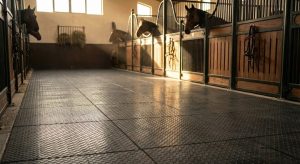
Most specialized horse stable flooring contractors in the UAE rely on rubber systems as the first choice, especially for indoor stables and standing/lying areas. These systems are supplied as square or rectangular mats, or in rolls, with thicknesses typically ranging from 10 mm up to 40 mm depending on the required protection level.
Key advantages of high-quality rubber horse stable flooring systems:
- Distributes the horse’s weight evenly and reduces pressure on joints and muscles.
- Provides a slightly textured surface with excellent slip resistance, even when slightly wet.
- Mats can be lifted if needed to clean underneath or to repair specific areas.
- Feels warmer under hooves compared to cold concrete, especially during cooler nights.
At Forsan Al Amal Alsarea, we select rubber systems specifically manufactured for equestrian environments—not generic industrial mats—to ensure they resist ammonia, urine, and the high temperatures commonly found in closed stables.
2. Concrete Base with Traditional Bedding
In some budget-sensitive projects, stable owners choose a well-executed concrete base combined with a deep bedding system (shavings or straw). This can be economical at the beginning, but it usually requires more labour to maintain bedding thickness and cleanliness. Concrete alone is not a comfortable surface if the bedding is reduced or becomes uneven.
When this solution is used, we recommend increasing the surface roughness of the concrete slightly to improve traction, and carefully designing slopes and drains to handle urine and wash water efficiently.
3. Wooden Flooring
Timber flooring gives a warm, traditional look to horse stable flooring in uae, but it is sensitive to moisture, insects, and ammonia. It can be used in specific projects with a heritage design, or in service areas, providing that proper insulation is installed beneath the boards and the surface is treated with moisture-resistant finishes.
In most horse stable flooring installation UAE projects, we prefer rubber or composite systems that can be washed frequently rather than wood, unless there is a very specific design requirement.
4. Sand and Improved Soil Floors
These are more common in outdoor arenas and exercise areas than inside stalls. Sand provides good comfort for hooves, but is difficult to keep clean and requires frequent levelling and topping up. In enclosed spaces, sand floors can lead to higher humidity and manure accumulation inside the soil layer.
5. Composite / Hybrid Flooring Systems
Modern hybrid systems combine rubber, plastic, and recycled materials to deliver high performance in shock absorption and slip resistance. They can be an excellent choice for premium projects or stables hosting high-value racehorses, but they must be designed and installed by experienced
horse stable flooring contractors familiar with these systems and their technical requirements.
Floor Layer Design in Horse Stable Flooring Installation UAE
Even the best horse stable flooring materials will not perform well if they are installed over weak or poorly prepared sub-layers. That’s why the engineering team at Forsan Al Amal Alsarea designs the flooring build-up from the ground up, as shown in the table below:
| Layer | Main Function | Approximate Thickness | Engineering Notes |
|---|---|---|---|
| Natural Soil (Subgrade) | Carries loads and transfers them to the ground | Variable | Must be well compacted and any soft spots treated before construction |
| Sub-base Layer | Distributes loads and improves drainage | 150–250 mm | Typically executed with crushed aggregates, compacted in layers |
| Concrete Slab / Structural Base | Provides the main level surface for flooring | 80–120 mm | Must be cast with proper slope towards drainage points and free of honeycombing or major cracks |
| Moisture & Chemical Barrier | Prevents water and ammonia rising into concrete or rubber | Depends on system | Can be a liquid waterproof coating or a dedicated membrane |
| Final Horse Stable Flooring (Rubber / Composite) | Provides comfort and safety for the horses | 10–40 mm | Thickness and density are chosen according to horse type and usage intensity |
Careful design and execution of each layer is what differentiates a truly professional project from a basic one in the world of
horse stable flooring installation UAE.
Step-by-Step Horse Stable Flooring Installation with Forsan Al Amal Alsarea
As one of the specialized horse stable flooring contractors in the UAE, Forsan Al Amal Alsarea follows a clear step-by-step methodology that ensures clean execution and well-studied details:
- Consultation and On-Site Assessment
You contact our team to schedule a site visit. During the assessment, we measure the spaces, review the condition of the existing ground, and discuss the type and number of horses, as well as your
long-term operational plan. - Recommending the Most Suitable Flooring System
Based on the collected data, we determine which horse stable flooring system is most appropriate: full rubber, concrete plus partial rubber, or composite systems—while clearly explaining the
advantages and limitations of each option. - Engineering Design and Pricing Proposal
The design includes slopes, drain locations, concrete and rubber thicknesses, and how to handle doors and wall joints. We then provide a detailed BOQ and cost breakdown for every work item. - Civil Works Execution
This includes sub-base preparation, levelling, concrete casting, forming slopes and drainage points, and surface treatment as per the agreed system. - Installation of Rubber or Composite Flooring
Mats or rolls are cut and installed precisely, with careful attention to joint directions, edge finishing, and ensuring full surface stability without gaps or trip points. - Handover and Maintenance Training
Once horse stable flooring installation is complete, our team explains the best cleaning methods, acceptable detergents, and how to handle minor damage or special stains.
Common Mistakes When Choosing or Installing Horse Stable Flooring.
Many farms start their projects with enthusiasm, only to discover after one or two years that they need to redo a large portion of the flooring. In most cases, the reason is one of the following:
- Using a general contractor with no equestrian experience instead of specialized
horse stable flooring contractors who truly understand horse behaviour and welfare. - Choosing non-equestrian rubber that wears out quickly or emits strong odors under heat and urine exposure.
- Pouring very smooth concrete with no surface treatment, creating a highly slippery floor when wet.
- Ignoring proper slopes and drainage design, which leads to urine and water pooling in corners that are hard to clean.
- Neglecting door and edge details, resulting in sharp edges or gaps where hooves can get caught or dirt builds up.
Avoiding these mistakes saves significant time and money over the lifetime of the project and turns your investment in
horse stable flooring into a smart, sustainable decision rather than a recurring problem.
How Much Does Horse Stable Flooring Cost in UAE?
Final cost depends on area, existing ground condition, system type, and desired finish level. The table below provides approximate ranges to help you build an initial budget:
| System | Description | Approx. Price per m² (AED) | Service Life | Best Use Case |
|---|---|---|---|---|
| Concrete + Bedding | Concrete base relying fully on bedding for cushioning | ~80–140 | Long for concrete, medium for bedding | Small projects or limited budgets |
| Standard Rubber Horse Stable Flooring | Medium-thickness rubber mats over concrete | ~180–260 | 10–12 years | Most commercial stables and training centers |
| High-Density Premium Rubber | Thicker, higher-density mats for heavy use and impact | ~260–350+ | Up to 15 years with good maintenance | Racehorse stables or high-value horses |
| Composite / Hybrid Flooring | Special systems for premium or highly specific applications | 350+ and above | 10–20 years | Luxury equestrian clubs and high-end tourism projects |
These numbers are indicative and give a general picture only. To obtain an accurate cost, a specialized engineer must inspect your site and prepare a detailed design-based quotation, which is exactly what the Forsan Al Amal Alsarea team offers as part of its professional
horse stable flooring installation UAE services.
Best Practices for Maintaining and Cleaning Horse Stable Flooring in uae
Even if you choose the best horse stable flooring in UAE, neglecting cleaning and maintenance will shorten its lifespan and increase odors inside the stable. We recommend a clear maintenance plan:
Daily Routine
- Remove manure immediately, or several times per day at minimum.
- Sweep the floor using appropriate tools, avoiding sharp metal edges that can scratch the rubber.
- Check drains and gullies to ensure there are no blockages.
Weekly / Monthly Routine
- Wash horse stable flooring with water and a mild animal-safe detergent.
- Inspect rubber mats for lifted edges, tears, or cracks.
- Review bedding levels in each stall and adjust as needed.
Long-Term Measures
- Re-secure rubber mats if they shift due to heavy traffic.
- Repair any damage to the concrete substrate before it worsens.
- Evaluate system performance every few years to ensure it still matches how the stable is being used.
How to Choose Between Horse Stable Flooring Contractors in UAE
The market is full of contractors, but only a few are truly specialized in horse stable flooring. When looking for
horse stable flooring contractors in the UAE, we recommend evaluating the following:
- Proven track record in stables or animal facilities, not just residential or industrial projects.
- Clear understanding of horse needs in terms of comfort, slip resistance, and how the floor behaves with urine and moisture.
- Ability to explain the full floor build-up from subgrade to final surface, not only the top rubber layer.
- Use of certified materials that are suitable for the UAE climate, supported by manufacturer data where possible.
- After-sales service and maintenance support instead of a one-time installation with no follow-up.
You can also review other flooring-related service pages from Forsan Al Amal Alsarea, such as
sports flooring in the UAE,
to better understand the company’s approach to designing and installing specialized surfaces of different types.
Why Forsan Al Amal Alsarea Is One of the Leading Horse Stable Flooring Contractors in UAE
Forsan Al Amal Alsarea brings together expertise in sports field and flooring construction with experience in building specialized environments for animals such as horse stables. This combination gives you a partner who understands engineering, animal welfare, and day-to-day operations on site.
- Extensive field experience in rubber and composite flooring projects across UAE—desert, coastal, and even cooler mountain regions.
- Custom solutions for each client, instead of forcing a single system on all projects.
- Commitment to quality and schedule through a trained installation team and active project management.
- Free initial consultation to help you understand your options before making a major investment in
horse stable flooring.
Case Study: Upgrading a Private Stable with Rubber Horse Stable Flooring
One of our clients in the UAE owned a small 10-horse stable with an old concrete floor. Over time, they noticed frequent slipping incidents, more complaints from staff about cleaning difficulty and odors, and increased bedding usage. After a site visit, our team proposed a
rubber horse stable flooring system with greater thickness in high-load standing areas, along with improved concrete slopes and drainage.
Once the project was completed within a short and agreed-upon timeframe, the owner noticed:
- A clear reduction in daily cleaning time.
- Better horse movement and significantly fewer slipping incidents.
- Lower bedding consumption thanks to the improved performance of the flooring itself.
This simple case illustrates how a smart investment in horse stable flooring can completely transform the stable experience for horses, staff, and owners alike.
Frequently Asked Questions About Horse Stable Flooring in UAE
1. What is the best horse stable flooring in UAE for comfort and safety?
In most projects, high-density rubber flooring installed over a properly designed concrete base is considered the best choice. It combines excellent comfort, strong slip resistance, easy cleaning, and long service life. However, the final system should always be selected by a specialist engineer after studying horse type, usage intensity, and site conditions.
2. What is the difference between economical and premium horse stable flooring systems?
Economical systems often rely on good concrete with heavy bedding or standard rubber mats. Premium projects, on the other hand, use thicker or more advanced rubber or composite systems, with special detailing in aisles, wash areas, and high-traffic zones, as well as additional aesthetic and design elements.
3. Do rubber horse stable floors still require bedding on top?
It depends on the system and horse behaviour. Many clients prefer a light bedding layer on top of rubber to increase absorption and make daily cleaning easier, while others rely on rubber alone with more frequent washing. The best approach can be decided after a short trial period in the actual stable.
4. How can I know if a company is truly specialized in horse stable flooring installation UAE?
Ask to see previous stable projects—not just sports courts or warehouses. Request details about materials, flooring thicknesses, drainage design, and post-installation maintenance plans. A company genuinely experienced in horse stable flooring will answer clearly and provide practical recommendations rather than generic statements.
5. Can an existing stable floor be upgraded without completely shutting down operations?
In many cases, yes. Work can be executed in phases, temporarily moving horses from one group of stalls to another while
horse stable flooring installation is completed in each section. This minimizes downtime and keeps the stable functional throughout the project.
6. What is the first practical step if I want to start a new horse stable flooring project?
The first step is to arrange a site visit with a specialist team such as Forsan Al Amal Alsarea. After that, you will receive a concise technical report with recommended systems, suitable
horse stable flooring types, and an initial estimate of cost and timeline, so you can make a clear and informed decision.
Conclusion – Horse Stable Flooring as a Long-Term Health and Financial Investment
Choosing and installing horse stable flooring is not a minor item in a stable project; it is at the heart of the daily experience for horses, staff, and visitors. The right flooring means more comfortable
horses, easier cleaning, fewer odors, and longer facility lifespan. The wrong flooring can consume your time and budget in endless repairs and operational headaches.
If you are looking for the best horse stable flooring in UAE and a trusted partner from among the various
horse stable flooring contractors, the Forsan Al Amal Alsarea team is ready to support you at every stage of the project—from initial concept to handing over a safe, comfortable, and efficient stable for your
horses and staff. Contact us today and turn your horse stable floors into a true strength of your project, not a hidden weakness.