Global Standards for Sports Fields: The Complete Technical Guide for Safety, Performance, and Long Term Quality in the UAE (Forsan Al Amal Al Sarea)
The global standards for sports fields are the practical foundation for building sports facilities that are safe, playable, durable, and easy to operate. Standards are not marketing statements. They are measurable requirements that define how a field should perform for athletes, coaches, referees, and spectators, and how the facility should behave after years of heat, UV exposure, sand, heavy use, and maintenance cycles in the UAE and GCC.
This guide explains what global standards include, how international frameworks typically evaluate sports fields, and how Forsan Al Amal Al Sarea applies engineering control across design, civil works, drainage, surfacing, lighting, perimeter safety, testing, and handover documentation to deliver consistent excellence. It is written for owners, developers, schools, clubs, consultants, and municipalities who want a technical reference that supports decisions from concept to operation.
Useful reference links:
Sports Facilities Planning Guidance (UAE reference PDF)
|
Expert Sports Field Construction
1) What Global Standards for Sports Fields Actually Mean
The phrase global standards for sports fields describes a collection of requirements that define how a sports facility should be designed, built, tested, and maintained. Depending on the sport and the project intent, standards can come from international governing bodies, testing programs, engineering guidelines, or local authority planning frameworks.
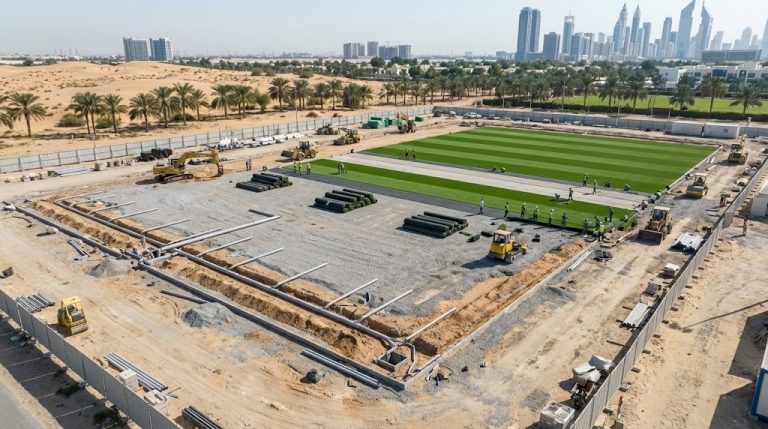
In technical terms, standards are successful only when they are translated into measurable site controls. A field does not become compliant because a product brochure says it is premium. Compliance is achieved when the design specifies the correct system build up, civil works deliver correct levels and slopes, drainage performs under real rainfall events, surfacing is installed with disciplined methods, and the final facility passes acceptance checks with documentation that supports safe operation.
A professional field is therefore a controlled delivery system, not a single construction activity. It begins with a clear definition of sport type and usage intensity and ends with a maintenance ready handover. This is the practical meaning of global standards in UAE conditions.
2) Why Standards Matter: Safety, Performance, Asset Value
Safety and injury reduction
Standards protect athletes by controlling traction, evenness, shock behavior, run off safety, equipment anchoring, and perimeter hazards. When standards are ignored, injuries increase, complaints rise, and facilities experience downtime and reputational damage.
Consistent playability and user satisfaction
Players feel quality through consistent ball interaction, predictable footing, and uniform lighting. Coaches and clubs depend on consistency to plan training. Schools depend on predictability for safeguarding and supervision. Standards translate these needs into measurable engineering outcomes.
Lower lifecycle cost
The cheapest facility is often the one that lasts. Standards protect the asset by preventing early failure at interfaces, edges, and base layers. Good drainage and correct sub base build up reduce settlement, ponding, and surface stress, which extends surface life and reduces corrective maintenance.
Compliance and project approvals
Many UAE projects require evidence of safe design, accessible planning, and proper documentation for handover. Standards and structured documentation reduce disputes, accelerate approvals, and provide a transparent acceptance pathway.
3) Who Defines Standards: FIFA, FIBA, ITF and Other Frameworks
Standards vary by sport. Football, basketball, tennis, athletics, rugby, hockey, and multi sport facilities each have different priorities. The role of international bodies is to define dimensions, performance priorities, and in some cases testing or certification programs that confirm field performance.
Common international reference bodies include:
- FIFA for football frameworks and performance pathways in relevant programs
- FIBA for basketball court geometry and facility recommendations
- ITF for tennis court classifications and guidance
- World Athletics for athletics track geometry and performance requirements
- World Rugby for rugby pitch requirements and safety considerations
- FIH for hockey field standards in relevant projects
- ASTM and ISO for test methods and material performance references in many construction and sports contexts
Not all projects require formal federation certification, but all projects benefit from the same engineering logic: measurable design, controlled execution, verified drainage, safe edges, and disciplined acceptance checks. This is how global standards for sports fields become practical and repeatable.
Useful external orientation links:
4) What Standards Cover: Dimensions, Surface, Lighting, Drainage, Safety
While details vary by sport, most standards for sports fields cover a similar scope:
- Field dimensions and geometry including run off areas and safety offsets
- Surface system suitability including traction, evenness, and sport specific interaction
- Drainage design including slopes, permeability, and discharge routes
- Lighting and visibility including uniformity and glare control for evening operation
- Safety measures such as perimeter containment, safe equipment anchoring, and hazard control
- Accessibility and user flow especially in schools and public facilities
- Documentation and operational readiness including testing evidence, as built records, and O and M guidance
A key point is that these items are interconnected. A drainage failure can damage the surface. A weak sub base can break line marking accuracy. Poor lighting creates safety risks even when the surface is good. Standards require a systems approach, not isolated decisions.
5) The Core Performance Metrics Behind Professional Fields
The best way to understand global standards for sports fields is to think in performance metrics. Metrics translate standards into inspection outcomes and acceptance tests. The exact values depend on the sport and the surface program, but the logic is consistent.
Evenness and level tolerance
Evenness affects player stability, ball movement, and drainage behavior. Poor tolerances lead to ponding, unpredictable bounce, and higher injury risk. Professional projects define measurable level tolerances and verify them at hold points before surfacing begins.
Traction and slip resistance
Traction must be consistent. Too little traction increases slips. Too much traction can increase joint stress and injury risk. Standards typically require the surface system to deliver predictable grip under dry and wet conditions and to avoid sudden traction changes across seams and interfaces.
Shock behavior and athlete comfort
Shock absorption and surface deformation influence comfort and fatigue. The goal is not softness for its own sake, but controlled energy behavior that protects joints and supports predictable play.
Ball interaction metrics
Football, hockey, tennis, and other sports depend on predictable ball behavior. Standards often consider ball roll, ball rebound, and consistency across the playing area. In multi use facilities, the design should clarify which sport performance is prioritized.
Drainage performance
Drainage performance is evaluated by the ability to prevent ponding and maintain traction and playability after rainfall or cleaning events. Drainage is not just a channel detail. It is slope logic, permeability, sub base design, and discharge planning combined.
Lighting metrics for evening use
Lighting is not only brightness. Uniformity and glare control determine whether a facility feels professional and safe. Poor aiming and excessive glare can damage play quality even if the field is otherwise well built.
Global Standards for Sports Fields in Practice: Turning International Requirements into Verified Site Outcomes
The phrase global standards for sports fields is often used loosely, but on real projects it means a measurable system: correct geometry, verified levels, engineered drainage, controlled surfacing installation, and acceptance evidence that supports safe play and predictable performance.
In the UAE, meeting global standards for sports fields is not achieved by selecting premium materials alone. It requires disciplined integration between design, civil works, drainage, surfacing, lighting, and perimeter safety, with clear testing and documentation at each milestone. This is where international sports field standards become practical, inspectable, and repeatable on site.
A Technical Framework That Aligns Global Standards with UAE Construction Reality
To deliver global standards for sports fields consistently, owners and consultants should treat the project as a sequence of controlled phases. This framework also supports procurement clarity and reduces rework, because sports field construction standards are translated into acceptance checkpoints, not assumptions.
- 1) Standards definition and scope control:
Start by defining which global standards for sports fields matter for your sport type and usage intensity. For football projects targeting competitive quality, align design intent with FIFA compliant sports fields principles, then document what is required and what is excluded to avoid late changes. - 2) Inspectable design package:
Convert global standards for sports fields into drawings and specifications that can be measured. This includes run-off zones, interface details, lighting layouts, drainage discharge routes, and surface build-up notes. Where relevant, reference international sports field standards as orientation while keeping the specification site-verifiable. - 3) Civil works and tolerance discipline:
The most common way to break global standards for sports fields is weak level control. Set tolerance targets early, verify them at hold points, and prevent cumulative error. This is a core pillar of sports field construction standards in high-traffic schools, clubs, and municipal facilities. - 4) Drainage and sub base verification:
If the drainage logic fails, global standards for sports fields cannot be sustained after opening. Verify slope direction, permeability readiness, inspection access points, and the discharge route. In professional sports field construction UAE, drainage is treated as a performance system, not a minor accessory. - 5) Surfacing, lighting, and perimeter safety integration:
Many facilities look good on day one but drift away from global standards for sports fields due to poor edge detailing, seam weakness, glare issues, or unsafe perimeters. Control adhesives, curing windows, seam methods, LED aiming, and safe fencing and gates. This integrated approach is a practical definition of professional sports field construction UAE.
When owners ask how to compare suppliers fairly, the answer is simple: request evidence that the contractor can deliver global standards for sports fields through documented checkpoints, not promises. A professional contractor should provide method statements, inspection test plans, material data sheets, and a handover pack that includes maintenance schedules and warranty clarity. This is the operational side of sports field construction standards.
How Standards Translate into Specifications That Prevent Disputes
The fastest way to protect global standards for sports fields is to specify requirements in a way that can be inspected. The following specification logic is used in controlled delivery and aligns with international sports field standards in principle, while remaining practical for UAE execution and supervision.
- Define measurable acceptance criteria:
For global standards for sports fields, define what will be checked at each stage (levels, slopes, compaction verification, drainage readiness, seam quality, lighting aiming) and who signs off the checkpoint to move forward. - Lock system compatibility:
Ensure the full system works together (sub base, shockpad where needed, surfacing, adhesives, edge restraints, and interfaces). This is essential in professional sports field construction UAE where heat cycles and dust loads punish weak interfaces. - Document performance intent for football projects:
If a football facility is expected to reflect higher-tier playability, state the performance intent clearly and align installation control and testing with the practical outcomes associated with FIFA compliant sports fields, even when formal certification is not required.
Mini FAQ for Owners and Consultants
Does repeating standards language in the tender guarantee quality?
No. Real compliance happens when global standards for sports fields are backed by measurable checkpoints, verified site records, and clear handover documentation that supports maintenance and safe operation.
What is the fastest technical indicator of a contractor who can deliver consistent results?
A contractor who delivers global standards for sports fields will show discipline in civil tolerances, drainage verification, surfacing installation control, and lighting aiming, supported by an inspection test plan and clear evidence at each milestone.
Related references:
Sports Field Construction UAE
|
Sports Infrastructure Construction
|
Expert Sports Field Construction
6) UAE Reality: Heat, UV, Sand, Humidity, and High Usage
UAE sites impose environmental loads that can accelerate failure if the design is copied from a mild climate without adaptation. A field that looks compliant on paper can fail in practice if heat cycles, UV exposure, and sand intrusion are not engineered into the specification.
- Heat affects adhesives, polymer coatings, and surface temperature behavior
- UV accelerates degradation in plastics, pigments, and some yarn systems without UV stable grades
- Sand and dust can clog drainage layers, contaminate infill, and increase abrasion in high traffic zones
- Humidity in coastal areas increases corrosion risk and can influence curing windows for coatings
- High usage intensity in schools and communities increases wear assumptions and demands stronger maintenance planning
In professional UAE projects, standards should be treated as minimum requirements. The correct approach is to specify for reality: higher exposure, higher use, stronger maintenance discipline, and controlled acceptance checkpoints.
7) Design and Planning: How to Translate Standards Into Drawings
Planning is where many projects win or fail. Design must translate global standards for sports fields into inspectable drawings and specifications. A drawing that only shows dimensions is not enough. A professional package describes the full system build up and the acceptance logic that protects quality.
A complete design and specification pack should include
- General arrangement with sport geometry, safety offsets, and run off areas
- Level and slope drawings showing finished levels and base levels
- Drainage layouts including discharge route details and inspection points
- Surface system build up with material layers and compatibility notes
- Edge restraint details, kerbs, and transitions to hardscape
- Lighting layouts, pole locations, foundations, and ducting routes
- Fencing and gate design with safety detailing and corrosion protection
- Inspection test plan, hold points, and acceptance criteria
The key success factor is measurability. If a requirement cannot be inspected, it will likely be compromised during execution. Forsan Al Amal Al Sarea structures specifications to be measurable, reducing disputes and preventing rework.
8) Civil Works Quality: Levels, Slopes, Tolerances, and Interfaces
Civil works define whether the facility can meet global standards after opening. Many owners focus on the visible surface, but most long term failures start in formation, levels, and interface details.
Civil controls that protect performance
- Benchmark control with a consistent coordinate reference to prevent cumulative error
- Cut and fill discipline to avoid weak fill zones without proper compaction
- Slope verification to ensure water moves away from play zones
- Tolerance checks at each layer so errors do not compound
- Interface planning for kerbs, ducting, fencing foundations, and gates to prevent later cutting
A small civil error can create visible surface defects. The professional approach is to lock quality early, before surfacing begins, using milestone acceptance.
9) Drainage and Sub Base: The Hidden System That Protects Everything
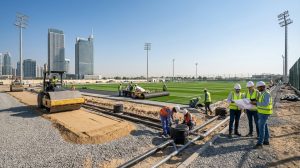
Drainage and sub base are the most decisive technical systems in sports field delivery. If the base layers are wrong, even premium surfacing will fail. Drainage is not a single item. It is the combination of slopes, permeability, compaction quality, and discharge route planning.
What a professional drainage and sub base must achieve
- Eliminate ponding and reduce slip risk
- Maintain structural stability under repeated athlete loads

- Provide consistent permeability without clogging
- Protect the surface system from moisture related stress
- Provide inspection and maintenance access
Typical layer logic in high quality UAE projects
The exact build up depends on geotechnical conditions and the surface system, but professional delivery commonly follows a controlled sequence:
- Formation preparation and compaction strategy
- Separation layer where required to prevent contamination
- Engineered aggregate layers with controlled grading
- Compaction verification at each stage
- Final leveling layer to meet surface tolerance targets
- Drainage components and discharge tie in verification
Drainage discharge route and legality
Drainage only works if water can discharge safely. The discharge route must be defined at design stage. In many sites, this is a key constraint that influences slope direction, outfall location, and the selection of drainage components.
Forsan Al Amal Al Sarea treats base readiness as a hold point. Surfacing does not start until levels, slopes, and drainage behavior are verified.
10) Surfacing Systems: Turf, Acrylic, PU, Modular, Hybrid, EPDM Zones
Surfacing must match sport type, usage intensity, maintenance capacity, and climate constraints. The same product can deliver very different results depending on base quality and installation discipline.
Artificial turf systems
Artificial turf is widely used in football, training, and multi use facilities. Professional projects control base flatness, seam alignment, perimeter fixing, and infill strategy where applicable. The goal is stable traction, predictable ball behavior, and long term seam integrity under high use.
Acrylic sports courts
Acrylic is common for tennis, basketball, and multi courts where line accuracy and consistent bounce are priorities. Successful delivery depends on substrate preparation, moisture control, layer sequencing, and curing window planning. Cracking and delamination are typically linked to poor civil works or rushed curing.
PU systems
PU systems can provide controlled traction and shock behavior for multi sport facilities. They demand strict substrate preparation and disciplined curing. Dust control and weather window planning are especially important in the UAE.
Modular tiles
Modular tiles offer fast installation and modular repair capability. However, base flatness remains critical. If the base is not within tolerance, users experience uneven feel, movement, or noise.
Hybrid and premium performance systems
Premium performance systems require high integration discipline. Interfaces and maintenance requirements must be defined early. These systems can deliver excellent performance when installed and maintained correctly, but they are less forgiving of shortcuts.
EPDM and rubber safety zones
Many UAE facilities combine sports fields with children activity zones or safe circulation areas. EPDM and rubber safety flooring can improve impact protection and reduce injury severity around high activity points. Successful performance depends on substrate readiness, adhesive quality, UV stability, and edge detailing that prevents lifting.
A surface system is only as strong as its weakest interface. Forsan Al Amal Al Sarea treats interfaces, edges, and transitions as core engineering scopes, not minor details.
11) Line Marking and Sports Equipment: Accuracy and Safety
Professional fields feel professional because details are controlled. Line marking must match sport geometry, remain visible, and avoid bleeding or fading under UV exposure. Equipment such as goals, posts, nets, and accessories must be installed with safe anchoring and durable corrosion protection.
Common controls
- Verify dimensions and offsets before marking
- Use marking systems compatible with the surface type
- Confirm goal anchoring strategy and safety padding where needed
- Ensure netting and accessories do not create hazards
- Document final geometry in as built records
12) LED Lighting Standards: Uniformity, Glare, Controls, Foundations
Lighting is often judged by brightness, but professional lighting quality is defined by uniformity and glare control. Poor lighting creates dark zones and uncomfortable glare, reducing play quality and increasing safety risk. Good lighting extends usable hours and increases facility value.
Key lighting principles
- Uniformity across the playing area to avoid bright and dark patches
- Glare control to protect athlete vision and spectator comfort
- Correct pole positioning aligned with orientation and run off areas
- Safe foundations with correct anchor bolt setting and corrosion considerations
- Protected cabling routes with ducting and secure control points
- Operational controls such as timers or zoning to reduce energy waste
A critical sequencing rule is simple: foundations and ducting must be completed before surfacing and final finishes. Cutting trenches later is one of the most expensive and destructive mistakes in sports facility delivery.
13) Perimeter Safety: Fencing, Gates, Run Off Areas, Access Control
Perimeter systems are part of safety, access control, and ball containment. They also influence supervision, crowd management, and maintenance access. In coastal or high exposure sites, corrosion protection becomes a key long term quality factor.
Perimeter requirements that should be specified clearly
- Fence height and mesh type aligned with sport and site risk
- Gate locations designed to reduce congestion and support emergency access
- Safe latches and tamper resistant detailing in public facilities
- Run off zones free from hard obstacles close to play areas
- Maintenance access routes that do not damage surfaces
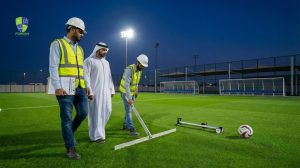
14) Quality Checkpoints and Testing: Acceptance That Prevents Failure
A professional facility is not achieved by one final inspection. It is achieved through progressive quality checkpoints that lock in quality early and prevent hidden defects from moving forward.
Typical acceptance checkpoints in professional projects
- Formation acceptance before engineered layers begin
- Compaction and level verification for each sub base layer
- Drainage readiness verification and discharge route confirmation
- Edge restraints and interfaces inspection before surfacing
- Surfacing installation QA including seams, bonding, and transitions
- Equipment installation safety checks and perimeter inspection
- Lighting aiming validation and control testing
- Final walkthrough with punch list closure and documentation completion
What owners should request at final acceptance
- As built drawings and updated layouts
- Product data sheets and installed material records
- Warranty documents and service response process
- Maintenance schedule and inspection checklist templates
- Commissioning records for lighting and electrical systems
This acceptance model reduces rework, improves safety confidence, and protects long term quality.
15) Handover and Documentation: O and M Packs and Warranty Readiness
Handover is where the facility becomes an operational asset. The handover pack should be practical for facility teams, not only formal paperwork. When documentation is weak, maintenance becomes inconsistent and warranty disputes become more likely.
A strong handover pack typically includes
- As built drawings and final geometry
- Material data sheets and traceability records
- Maintenance schedule by surface system
- Inspection checklist templates and recommended frequency
- Cleaning guidance and approved chemical notes where relevant
- Spare parts list and consumables list where applicable
- Warranty terms, exclusions, and service contact pathway
16) Maintenance Standards: The Difference Between 3 Years and 10 Years
Maintenance is the most underestimated part of global standards for sports fields. Even the best installation can degrade quickly if daily operation is unmanaged. A predictable routine prevents small defects from becoming major hazards and protects surface performance.
Maintenance layers used by high performing facilities
- Daily or weekly debris removal, visual safety scan, basic perimeter check
- Monthly edge inspection, seam checks, drainage point review, high wear zone review
- Quarterly deeper inspection, corrective actions, lighting functional checks
- Seasonal adjust cleaning frequency for sand patterns and heat exposure cycles
Surface specific maintenance notes
- Artificial turf brushing routines, seam monitoring, infill control where applicable
- Acrylic and PU correct cleaning, crack monitoring, repaint planning based on wear
- Modular fastener integrity and module replacement planning
- EPDM zones early repair of small cracks and edge bonding inspection
Facilities that follow a disciplined maintenance routine stay closer to their intended standard and cost less to operate over the lifecycle.
17) How Forsan Al Amal Al Sarea Delivers Excellence in the UAE
Forsan Al Amal Al Sarea delivers sports fields by treating standards as an end to end delivery system. The method focuses on controlling the elements that most often cause failure: civil works tolerances, drainage and sub base integrity, interface detailing, installation discipline, and acceptance checkpoints with documented evidence.
1) Performance definition and scope alignment
Every project begins by defining sport type, usage intensity, operational hours, and maintenance capacity. This prevents under specification and protects budget from late changes.
2) Inspectable design and specification
Specifications are written in measurable terms so quality can be verified on site. This includes levels, slopes, layer build up, drainage strategy, and interface details.
3) Controlled procurement and material traceability
Materials are controlled through technical submittals, approved data sheets, and compatibility checks across the system, not only individual products.
4) Milestone acceptance and quality checkpoints
Key stages are treated as hold points. Surfacing does not begin until base and drainage readiness are verified. Final acceptance includes documentation and operational readiness.
5) Handover focused on operations
The handover pack is designed for real facility teams: clear maintenance routines, inspection templates, and warranty clarity that protects the asset after opening.
Related technical references on the Forsan website:
18) Common Mistakes That Break Global Standards
- Starting without measurable requirements leading to wrong system selection and substitutions
- Ignoring drainage and sub base causing ponding, settlement, and surface failure
- Skipping tolerance control allowing civil errors to compound
- Late lighting planning forcing ducting cuts after finishes
- Weak edge detailing causing lifting, seam separation, and trip hazards
- No maintenance plan allowing minor defects to become safety issues
- UV and heat under specification accelerating degradation in UAE exposure
19) Owner Checklists and Specification Templates
Checklist A: Before design begins
- Define sport type and user profile
- Confirm usage intensity and operational hours
- Define performance priorities and budget reality
- Confirm maintenance capacity and who will operate the field
- Request a measurable design pack with acceptance checkpoints
Checklist B: Before civil works start
- Confirm discharge route and drainage strategy
- Approve sub base build up and compaction verification method
- Set tolerance targets for levels and slopes
- Confirm interface details for kerbs, gates, fencing, and ducting
Checklist C: Before surfacing installation
- Verify base flatness and slope acceptance
- Confirm approved materials and compatibility across the system
- Confirm curing windows and dust control plan
- Confirm edge restraint readiness and transition details
Checklist D: Before final handover
- Close punch list items with documented evidence
- Receive as built drawings and product data sheets
- Receive warranty terms and service response pathway
- Receive maintenance schedule and inspection templates
- Confirm lighting and electrical commissioning records
20) FAQ
Do all sports fields need federation certification to follow global standards?
Not every project needs formal certification, but every project benefits from the same engineering discipline: correct geometry, controlled civil works, verified drainage, safe surfacing installation, and documented acceptance.
What is the most common reason sports fields fail early in the UAE?
Weak drainage and sub base execution is a leading cause. Surface systems reflect base quality. Ponding and settlement often start below the surface.
How can an owner reduce lifecycle cost without reducing quality?
Define measurable requirements, enforce hold points during execution, and implement a predictable maintenance routine from day one.
How important is lighting to standards?
Lighting affects safety, play quality, and user satisfaction. Uniformity and glare control are as important as brightness, and foundations and ducting must be sequenced early.
21) Conclusion
The global standards for sports fields define more than technical details. They define the safety of athletes, the quality of play, the comfort of spectators, and the long term value of the facility. Achieving these standards in the UAE requires a systems approach that integrates design, civil works, drainage, surfacing, lighting, perimeter safety, acceptance testing, and maintenance planning into one controlled delivery method.
Forsan Al Amal Al Sarea delivers excellence by controlling the stages that matter most: inspectable specifications, verified base and drainage readiness, disciplined installation, milestone acceptance checkpoints, and operation ready handover documentation that protects the field long after opening.