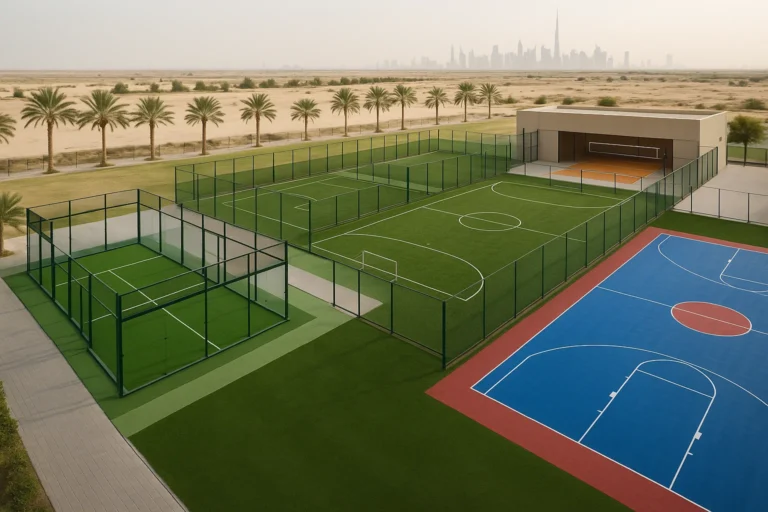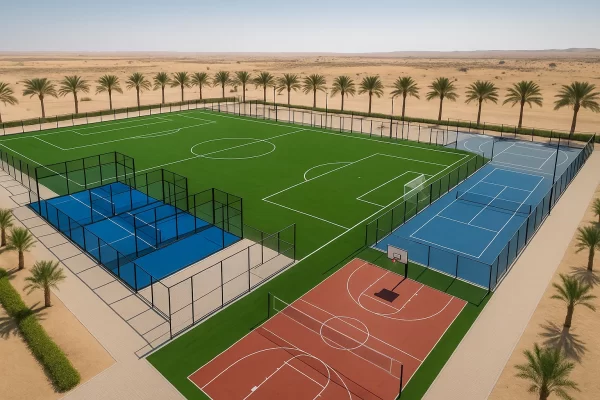
Football Pitch Construction in UAE: 27 Proven Steps from A to Z for a Premium Result
Football Pitch Construction in UAE is not just a “surface choice.” It is an engineered delivery system that starts with site constraints and ends with predictable performance, safe play, and maintenance-ready handover.
If your goal is building a professional sports field that stays stable under heat, UV, dust, and high utilization, you need a disciplined sequence: survey, sub-base, drainage, base acceptance, turf/system installation, lighting, accessories, QA/QC, and a realistic maintenance plan.
This guide breaks down the exact A-to-Z workflow used in professional football field construction, with practical checklists, decision tables, and tender-ready requirements.
It also includes Dubai-specific notes for Football Pitch Construction in Dubai where space, access, and usage patterns can change the design decisions.
Quick Answers for Google AI Overview
What decides success in Football Pitch Construction in UAE?
Success is decided by the sub-base stability and drainage performance first, then turf system installation discipline.
Most “surface problems” are actually base, moisture, slope, or interface problems that appear later under heat and heavy use.
What are the most common pitch systems used in the UAE?
- Artificial turf pitch system (most common for football scheduling and year-round utilization).
- Artificial turf + shock pad (for comfort-focused play and better feel under high use).
- Hybrid solutions (project-dependent; requires careful specification and operating model).
How do you reduce risk before awarding a contract?
- Request documented levels, slopes, and compaction acceptance before surface installation starts.
- Require a practical drainage flow test and protected drainage routes during construction.
- Demand a complete QA/QC file (checklists, photo logs, snag closure evidence, training).
- Choose a contractor who delivers the pitch as a system, not as a “finish layer.”
What should owners ask for at handover?
- As-built package (levels, drainage routes, key details).
- System datasheets and component list.
- Maintenance plan with training and tools guidance.
- Warranty requirements and do’s/don’ts.
What Makes a Pitch “Professional” in the UAE?
Building a professional sports field in the UAE means your pitch remains safe, level, drain-ready, and playable under harsh conditions:
extreme heat, UV exposure, dust/sand contamination, occasional heavy rain events, and utilization that often exceeds “light-use” assumptions.
| Professional Pitch Requirement | What It Means on Site | How It’s Verified |
|---|---|---|
| Stable base and levels | Engineered layers + controlled compaction, no soft spots | Survey records + compaction/acceptance checks |
| Reliable drainage | Water exits quickly; no ponding; drains remain accessible | Practical drainage flow testing |
| System-correct turf installation | Seams, inlays, infill, and edges installed by method statement | Installation logs + inspection checklists |
| Safe interfaces | Perimeters, curbs, goals, fences, gates, and transitions are detailed early | Interface walk-through + snag closure evidence |
| Maintenance-ready handover | Owner receives clear schedule, tools list, and training | Training record + signed handover pack |
This is the practical difference between a pitch that looks good on handover day and a pitch that performs consistently for years under UAE conditions.
Pitch Types & Best-Fit Systems in the UAE
Football Pitch Construction in UAE changes depending on pitch size, location constraints, and utilization intensity.
The right decision is the one you can maintain consistently—weekly, not “when time allows.”
Selection Matrix (Quick Decision Support)
| Pitch Type | Best Use | Common System | Key Risk | Best Control |
|---|---|---|---|---|
| 11-a-side pitch | Academies, clubs, municipal facilities | Artificial turf (option: shock pad) | Drainage errors become costly | Strict base acceptance + drainage test |
| 7-a-side / 9-a-side | Schools, communities, training | Artificial turf | High wear at goal areas | Reinforced wear strategy + grooming plan |
| 5-a-side / rooftop | Hotels, rooftops, compact urban sites | Artificial turf with perimeter detailing | Edge/interfaces and drainage constraints | Early detailing + protection of outfalls |
For broader facility planning beyond football, explore:
Expert Sports Field Construction and
Sports Infrastructure Construction.
1) Selecting the Right Location
The first step in Football Pitch Construction in UAE is choosing a site that supports performance and operations, not just dimensions.
A professional pitch needs space for run-offs, safe access, and a realistic drainage outfall plan.
Site checklist (what to confirm before design)
- Space: pitch footprint plus safe run-off zones and perimeter works.
- Access: equipment access for construction and future maintenance operations.
- Utilities: power availability for lighting and facilities.
- Drainage outfall: where water goes in real conditions (not only on drawings).
- Operating model: expected daily hours and peak scheduling intensity.
In Football Pitch Construction in Dubai, access windows, compact sites, and mixed-use developments often require earlier coordination on logistics, noise restrictions, and site protection.
2) Planning and Design
Design is not only a layout. It is the translation of sport intent into levels, slopes, drainage, system specifications, and future maintenance reality.
Building a professional sports field starts here—when the project is still easy to control.
Design decisions that affect performance
- Pitch intent: training, academy, community use, or semi-professional operations.
- System choice: turf specification, optional shock layers, and accessories.
- Drainage concept: surface falls + subsurface routes + inspection access.
- Perimeter and safety: curbs, fencing, gates, goal anchoring, and transitions.
- Lighting concept: poles, lux target, glare control, and maintenance access.
What to align early with your contractor
| Item | Why It Matters | Owner’s Best Question |
|---|---|---|
| Levels and slopes | Prevents ponding and uneven play feel | “How will you record and sign off levels before turf?” |
| Drainage routes | Controls water behavior during rain events | “Where does water go, and how is it tested?” |
| Interfaces | Most failures happen at edges and details | “Show me edge details and protection plan.” |
| Maintenance plan | Protects performance and warranty | “What weekly plan is realistic for our facility?” |
Sports Field Construction in UAE: Why System-Based Execution Matters
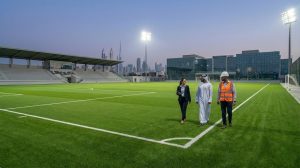
Sports Field Construction in UAE requires a system-based approach rather than isolated construction activities. In local conditions, heat exposure, dust, high utilization rates, and sudden rain events can quickly expose weaknesses in base preparation, drainage design, or interface detailing. That is why successful delivery depends on integrating survey accuracy, sub-base engineering, surface installation, and long-term maintenance into one coordinated workflow.
When building a professional sports field in the UAE, the visible surface—whether artificial turf, acrylic, or PU—represents only the final layer of a much deeper engineering process. Projects that treat sports field construction as a complete system consistently achieve better performance, longer lifecycle value, and fewer post-handover issues.
In practice, Sports Field Construction in UAE succeeds when drainage performance is verified before surface installation, base levels are documented rather than assumed, and transition zones such as edges, drains, and goal areas are detailed early in the construction phase. These controls transform a standard project into a professional sports facility capable of maintaining consistent play quality under UAE operating conditions.
3) Preparing the Ground (Earthworks + Sub-Base)
Ground preparation is the foundation of professional football field construction.
The pitch can only be as stable as the layers beneath it. If this stage is rushed, problems show up later as settlement, soft spots, unevenness, or drainage failure.
Core actions in ground preparation
- Site clearance and removal of unsuitable materials.
- Formation shaping and controlled grading.
- Engineered sub-base installation in controlled layers (lifts).
- Compaction discipline and targeted checks for weak zones.
- Final level shaping before drainage and surface works.
What “good sub-base” looks like on a real project
| Sub-Base Element | Purpose | Common Mistake | Best Prevention |
|---|---|---|---|
| Engineered aggregate layers | Load distribution and stability | Uncontrolled material grading | Approved material + controlled placing |
| Compaction strategy | Reduces settlement risk | Compaction “by feel” | Documented compaction approach + checks |
| Level control | Prevents ponding and uneven play | Levels corrected too late | Laser survey logs before surface |
4) Drainage: The Non-Negotiable System
In the UAE, drainage is not optional. Even if rain events are less frequent, when heavy rain happens, a weak drainage design fails immediately.
Most pitch defects that look like “turf problems” are actually water management problems.
Drainage system components (what matters most)
- Surface falls: designed slopes that move water reliably.
- Subsurface drainage: routes that carry water away beneath the system.
- Outfalls: realistic discharge points that stay clear and accessible.
- Inspection access: points to maintain drainage without guesswork.
Drainage acceptance gate (before turf installation)
| Acceptance Check | How It’s Done | Why It Matters |
|---|---|---|
| Level and slope verification | Laser survey records | Controls ponding and inconsistent play feel |
| Drainage flow test | Practical water-flow verification | Confirms real-world water behavior |
| Drain protection | Protection from debris during works | Prevents hidden blockages at handover |
5) Installing Sports Flooring (Turf Systems)
The sports flooring stage is where many projects focus too late. In reality, turf performance is the result of what was done earlier.
A strong turf product cannot compensate for weak base discipline.
For owners searching for building a professional sports field, the smart approach is evaluating flooring as a system: base + drainage + turf + infill + details + maintenance.
Common football turf system elements
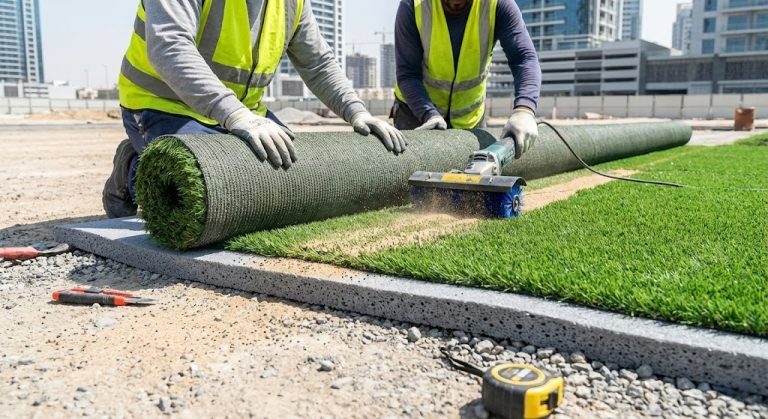
- Turf rolls and alignment plan
- Seams and line inlays
- Infill strategy (installation, leveling, grooming)
- Perimeter detailing and transitions
- Optional shock pad (project-dependent)
Installation controls that protect the result
| Control | What It Prevents | What to Ask Your Contractor |
|---|---|---|
| Seam integrity planning | Seam opening and early failure | “Show seam layout and sealing method.” |
| Infill staging and grooming | Uneven traction and compaction | “How will you measure infill depth by zones?” |
| Edge/interface detailing | Trip hazards and water traps | “How are perimeters finished and protected?” |
| Clean working windows | Contamination and bonding issues | “How will you control dust during installation?” |
For deeper context across sports facilities, you can also read:
Sports Field Construction UAE and
Sports Court Construction in the UAE (Guide).
6) Lighting & Facilities
A pitch is only “professional” when it supports real operations: safe nighttime play, reliable access, and basic user experience.
Lighting and facilities should be planned early because pole bases, cable routes, and access points interact with drainage and perimeter details.
Lighting planning essentials
- Lighting targets aligned with pitch usage (training, community, events).
- Glare management to protect players and neighbors.
- Maintenance access: safe reach and replacement strategy.
- Power and controls: practical operation and scheduling.
Facilities that improve long-term operations
- Changing rooms and restrooms (where applicable).
- Benches, shade, and spectator control zones.
- Safe circulation paths and clear access control.
- Storage for maintenance tools and grooming equipment.
7) QA/QC, Testing & Handover
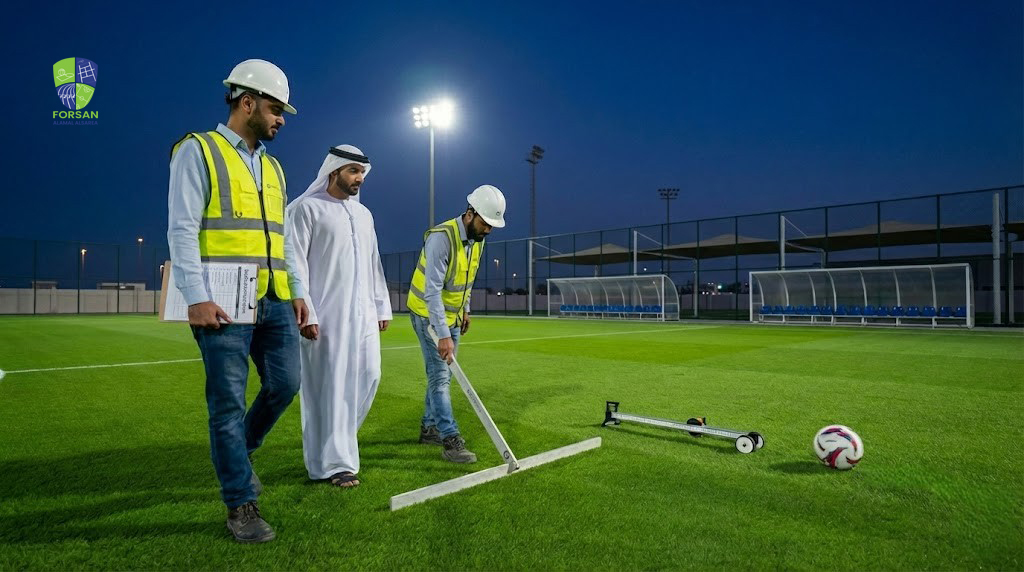
Quality is not an opinion—it is measurable acceptance criteria and documented evidence.
In Football Pitch Construction in UAE, the fastest way to protect your project is to require acceptance gates before surface works and a complete handover pack at completion.
QA/QC checklist (minimum package to request)
| Stage | What Must Be Checked | Evidence to Collect |
|---|---|---|
| Base acceptance | Levels, slopes, stability, soft spots | Laser survey logs + acceptance sign-off |
| Drainage acceptance | Flow routes, access points, protection | Flow test record + photo log |
| Turf installation | Seams, inlays, edges, infill staging | Installation logs + inspection checklist |
| Safety and interfaces | Perimeters, transitions, goals, gates | Snag list + closure evidence |
| Handover | As-built pack + maintenance training | Signed handover pack + training record |
Handover deliverables (what “professional” includes)
- As-built package (levels, drainage routes, perimeter details).

- System datasheets and component list.
- QA/QC checklists and snag closure evidence.
- Maintenance schedule and training record.
- Warranty requirements and operating do’s/don’ts.

External references often used for governance and standards:
FIFA,
ISO,
ASTM.
8) Routine Maintenance That Protects Performance
The project is not finished at handover day. Performance stays stable only when maintenance is consistent.
The best strategy is choosing a pitch system that your facility team can maintain weekly—without exceptions.
Simple maintenance schedule (practical and realistic)
| Frequency | Maintenance Actions | What It Prevents |
|---|---|---|
| Weekly | Debris removal, grooming/brushing high-use zones, quick edge inspection | Infill compaction, uneven traction, early seam stress |
| Monthly | Infill leveling checks, deeper grooming, goal-mouth wear review | Accelerated wear and localized failure |
| Quarterly | Drain access inspection, perimeter checks, minor repairs | Hidden drainage issues and edge-related defects |
| Annually | Condition assessment, refresh plan, scheduled repairs window | Sudden performance drops and unscheduled downtime |
Maintenance mistakes that shorten pitch life
- Ignoring early defects (small issues grow fast under heavy use).
- Allowing dust buildup without grooming discipline.
- Blocking drainage routes with landscaping or storage.
- Using unapproved tools or harsh chemicals that damage the system.
Typical Timeline Logic (What Happens First)
Every project is different, but strong outcomes follow the same logic: scope lock, base/drainage, system installation, QA/QC, and handover.
When base acceptance is skipped, timelines get longer due to rework—not shorter.
| Phase | Main Activities | Most Common Risk | Best Control |
|---|---|---|---|
| Scope & design lock | Layouts, details, drainage concept, system selection | Scope drift | Early sign-off on interfaces and outfalls |
| Earthworks & sub-base | Formation, layers, compaction, level control | Soft spots and settlement | Controlled layers + acceptance checks |
| Drainage installation | Routes, access points, protection | Hidden blockages | Flow tests + debris protection |
| Turf system installation | Seams, inlays, infill staging, detailing | Inconsistent play performance | Method statement + inspection logs |
| Lighting & accessories | Pole works, cabling, goals, fences, gates | Interface conflicts | Coordination and staged inspections |
| QA/QC & handover | Snag list, closure, training, documentation | Incomplete documentation | Checklist-based sign-off |
Common Failure Reasons in UAE Projects (and How to Prevent Them)
Many pitch issues are predictable. The best projects prevent them with acceptance gates and discipline.
If your goal is building a professional sports field, focus on the risks that UAE conditions accelerate.
Top failure reasons
- Base acceptance skipped: unevenness and ponding appear after installation.
- Drainage outfall ignored: water has nowhere to go in real rain events.
- Dust contamination during installation: bonding issues and inconsistent finish.
- Edge interfaces improvised at the end: trip hazards and water traps.
- Maintenance under-resourced: infill compaction and early performance drop.
What consistently prevents failure
- Documented levels/slopes and acceptance sign-off before turf installation.
- Drainage flow testing and protected routes throughout construction.
- Method statement compliance, clean working windows, and trained crews.
- Early interface detailing and perimeter control.
- A maintenance plan that is operationally realistic.
Tender & Procurement: What to Put in Your Scope
If you want predictable outcomes in Football Pitch Construction in UAE, your scope must define the delivery as a system.
A “surface-only” scope invites shortcuts and future disputes.
Scope items that strengthen tender clarity
- Base acceptance criteria (levels, slopes, stability checks).
- Drainage concept, outfalls, and practical flow testing requirement.
- Turf installation method statement, seam plan, and infill installation approach.
- Interface detailing: edges, perimeters, goals, gates, and transitions.
- QA/QC checklists, snag closure evidence, and handover deliverables.
- Maintenance schedule and training requirements.
For broader construction scopes across sports facilities, review:
Guide to Sports Court Installation and
Sports Court Construction in the UAE.
Recommended Internal Links (Forsan)
FAQ
1) What is the most reliable system for Football Pitch Construction in UAE?
Artificial turf systems are commonly selected for consistent scheduling and year-round utilization. The final result depends on base and drainage acceptance, not turf alone.
2) How is Football Pitch Construction in Dubai different from other Emirates?
Dubai projects often have tighter sites, stricter access windows, and higher utilization expectations. Early logistics coordination, perimeter detailing, and drainage outfall planning become even more critical.
3) Why do pitches fail even when the turf is premium?
Most failures come from base instability, slope errors, hidden drainage issues, and poorly detailed interfaces. Turf quality cannot compensate for weak foundations.
4) What should be verified before turf installation starts?
Levels and slopes, stability/soft spots, and a practical drainage flow test. This acceptance gate prevents the majority of costly defects.
5) What is the best way to keep a pitch performing under UAE dust conditions?
Weekly debris removal and grooming is essential. Dust buildup and neglected grooming accelerate compaction and reduce traction stability.
6) What does “building a professional sports field” mean in practical terms?
It means system delivery: engineered base, verified drainage, disciplined turf installation, safe interfaces, documented QA/QC, and maintenance-ready handover.
7) What should a handover package include?
As-built package, system datasheets, QA/QC checklists, snag closure evidence, and a maintenance plan with training and tool guidance.
8) How do you reduce downtime over the pitch lifecycle?
Start with a system you can maintain weekly, keep drainage access clear, fix small defects early, and schedule periodic assessments and refresh planning.
9) Which external bodies are commonly referenced for standards?
Projects often reference international governance and standards bodies such as FIFA, ISO, and ASTM, depending on project requirements and consultant specifications.
10) Why choose Forsan Al-Amal AlSarea?
Because the pitch is delivered as a complete engineered system: design coordination, base and drainage discipline, turf installation control, QA/QC evidence, and handover training for long-term performance.
Professional Delivery Standards for Football Pitch Construction in the UAE
Football Pitch Construction in UAE follows stricter technical and operational standards than general landscaping or civil works. A professional pitch must be engineered to support continuous play, player safety, and long-term surface stability under extreme climate conditions. This is why experienced teams approach football projects as part of a broader Sports Field Construction in UAE framework rather than isolated installations.
Successful Football Pitch Construction in Dubai and across the UAE depends on selecting qualified Sports Flooring Contractors in UAE who understand how base preparation, drainage, and surface systems interact as one unit. Whether the project involves artificial turf, hybrid grass, or advanced shock-absorbing layers, each component must be installed according to a coordinated system plan.
When building a professional sports field, the execution method matters as much as the materials used. High-performance facilities rely on Professional Sports Flooring Installation supported by verified levels, controlled curing periods, and clearly defined quality checkpoints. These practices ensure that Outdoor Sports Flooring Solutions deliver consistent performance and remain serviceable throughout their intended lifecycle.
In the UAE market, projects that combine Football Pitch Construction in UAE with system-based planning and documented quality control consistently outperform surface-only installations. This integrated approach defines modern Sports Field Construction in UAE and is the benchmark for reliable, future-ready sports facilities