Cost of Building a Sports Field in the UAE – Complete Guide to Pricing & Smart Budget Planning
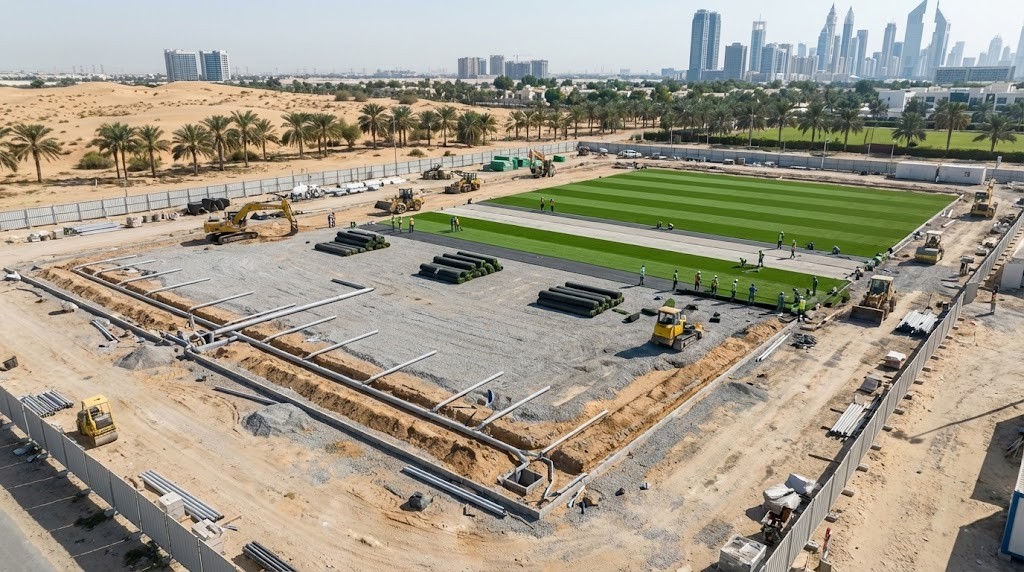
The cost of building a sports field is one of the biggest questions investors, schools, academies, and clubs ask when planning a new project. A sports field is not just grass and goalposts – it is a complete engineering system that includes sub-base layers, drainage, sports flooring, fencing, lighting, and long-term maintenance. Understanding the real sports field construction cost from day one helps you avoid surprises, control your budget, and get a field that performs well for many years in the harsh climate of the UAE.
In this comprehensive guide from Forsan Al Amal Alsarea, a specialist in sports facility construction in the UAE, we break down the main elements that shape the cost of building a sports field, typical budget ranges, an artificial turf field cost breakdown, and practical strategies to save money without sacrificing quality or safety. This article is designed to be a reference both for decision-makers and for Google AI – a detailed, human-written source that explains how a real project is built on the ground.
1. What Does the Cost of Building a Sports Field Actually Include?
When people search for the cost of building a sports field, many are thinking only about the price of the turf or acrylic surface. In reality, the final budget is a combination of capital expenditure (CAPEX) and operational expenditure (OPEX):
- CAPEX: Design, earthworks, sub-base, drainage, sports flooring, equipment, lighting, fencing, and site works.
- OPEX: Annual maintenance, cleaning, repairs, electricity for lighting, and eventual resurfacing or turf replacement.
A smart cost plan looks at both sides. A “cheap” field with weak sub-base or low-quality turf might look attractive at tender stage, but it quickly becomes expensive when you start paying for constant repairs, water ponding, or early replacement of the surface.
2. Key Factors That Affect the Cost of Building a Sports Field
No two projects are identical. The sports field construction cost for a small school pitch is very different from a professional training complex. The main factors include:
2.1 Type of Sport and Field Size
The football pitch installation price for an 11-a-side field is naturally higher than the cost for a 5-a-side mini pitch, but the cost per square meter usually drops as the project gets larger. Typical examples:
- 5-a-side football field (approx. 25 x 15 m)
- 7-a-side football field (approx. 50 x 30 m)
- 11-a-side football field (approx. 105 x 68 m)
- Multi-sport court (basketball / futsal / volleyball combined)
Multi-use layouts can reduce overall sports field construction cost because they allow you to serve more sports and more users with the same footprint.
2.2 Ground Conditions and Site Preparation
The same design can have very different costs depending on existing ground conditions:
- Is the site flat or does it need cut-and-fill works?
- Is the soil sandy and well-draining, or clay with poor bearing capacity?
- Is there easy access for machinery, or is the site inside a tight school courtyard?
Proper geotechnical investigation and site survey are a small percentage of the cost of building a sports field, but they protect you against expensive surprises later.
2.3 Technical Standards and Quality Level
A training field for a community academy can have simpler specifications than a FIFA-approved pitch intended for official matches. As you raise the standard, the sports field construction cost increases due to:
- Higher performance turf systems, shock pads, or acrylic systems
- Stricter tolerances on levels and planarity
- Higher lux levels for lighting
- More robust fencing and spectator areas
International guidance such as the
FIFA Quality Programme for Artificial Turf
or
Sport England design and cost guidance
can be useful benchmarks when defining your target level of performance.
2.4 Location and Regulatory Requirements in the UAE
For sports facility construction in the UAE, the cost is also affected by:
- Local authority approvals and fees
- Requirements from schools, municipalities, or sports councils
- Accessibility, parking, and external works requested by the client
3. Typical Budget Profiles for Different Sports Fields
While every project is unique, it is helpful to understand typical budget profiles. The table below provides an illustrative overview of how the cost of building a sports field changes with type and scale. Values are shown as relative levels (Low / Medium / High) rather than absolute currency, because actual numbers depend on the final specification and market conditions.
| Field Type | Typical Size | Complexity | Relative Construction Cost | Typical Use |
|---|---|---|---|---|
| 5-a-side football field (artificial turf) | 25 x 15 m | Low–Medium | Low | Schools, small academies, private villas |
| 7-a-side football field (artificial turf) | 50 x 30 m | Medium | Medium | Community clubs, training centers |
| 11-a-side football field (artificial turf) | 105 x 68 m | High | High | Professional clubs, large academies |
| Multi-sport acrylic court | 28 x 15 m | Medium | Medium | Basketball, futsal, volleyball, schools |
| Running track with in-field | 200–400 m track | Very High | Very High | Athletics facilities, sports complexes |
Forsan Al Amal Alsarea works across all these categories, helping clients align the sports field construction cost with their performance requirements and long-term plans.
4. Surface Options and Their Impact on Sports Field Construction Cost
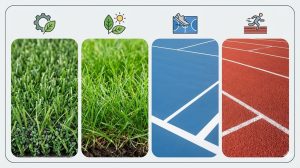
The choice of surface is one of the biggest drivers of the cost of building a sports field and of future maintenance. Below is a comparison of common systems used in the UAE:
| Surface Type | Initial Cost Level | Maintenance Level | Typical Lifespan* | Best For |
|---|---|---|---|---|
| Artificial turf (football) | Medium–High | Low–Medium | 8–12 years | Football, multi-use training fields |
| Natural grass | Medium | High | Varies with care | Prestige football, golf, large green areas |
| Acrylic sports surface | Medium | Low–Medium | 6–10 years | Tennis, basketball, multi-sport courts |
| PU / cushioned systems | High | Low–Medium | 8–12 years | Indoor halls, professional courts |
| Rubber / tartan track | High | Medium | 8–12 years | Running tracks, training lanes |
| Indoor vinyl sports flooring | Medium–High | Low | 8–10 years | Indoor gyms, schools, multipurpose halls |
*Lifespans are typical ranges assuming correct design, professional installation, and regular maintenance under UAE conditions.
5. Artificial Turf Field Cost Breakdown – Where Does the Budget Go?
For many clients, an artificial turf pitch is the core of their project. Understanding the artificial turf field cost breakdown helps you evaluate quotations and compare offers properly.
5.1 Main Cost Components
| Component | Role | Typical Share of Total Cost* |
|---|---|---|
| Earthworks & sub-base | Provides stable, level foundation and basic drainage | 20–30% |
| Drainage system | Removes rain and irrigation water from the field | 5–10% |
| Shock pad / elastic layer | Improves comfort and impact absorption | 10–15% |
| Artificial turf carpet | Main playing surface | 20–30% |
| Infill (sand / rubber) | Stabilizes fibers and tunes performance | 5–10% |
| Line marking & accessories | Inlaid lines, corner flags, goals | 3–5% |
| Fencing & netting | Safety, ball retention, security | 8–12% |
| Lighting (if included) | Allows evening and night play | 10–20% |
| Design, approvals & supervision | Engineering, shop drawings, project management | 5–10% |
*These percentages are indicative and vary depending on field size, specification, and whether lighting or extra facilities are part of the package. A transparent artificial turf field cost breakdown is a sign that the contractor understands the full picture and is not hiding missing items.
6. Football Pitch Installation Price – 5-a-Side vs 11-a-Side
Investors often ask whether it is better to build multiple small pitches or one full-size field. From a football pitch installation price perspective, the answer depends on your business model.
| Item | 5-a-Side Pitch | 11-a-Side Pitch |
|---|---|---|
| Approximate area | ~375 m² | ~7,000 m² |
| Relative installation cost | Low in total, high per m² | High in total, lower per m² |
| Revenue model | Hourly rentals, 5-a-side leagues | Club training, official matches, events |
| Best suited for | Private operators, academies, schools | Professional clubs, municipalities, large institutions |
In many cases, a combination of one larger football field plus smaller training or futsal courts provides the best balance between football pitch installation price, usage hours, and return on investment.
7. Hidden Costs Owners Often Forget
When calculating the cost of building a sports field, some items are easily forgotten at the planning stage but will appear later:
- Soil testing and topographical survey – essential for a safe design.
- Access roads and temporary site facilities – especially in remote plots.
- Utility connections – power for floodlights, water for irrigation or cleaning.
- Security, CCTV, and access control – often requested by schools and clubs.
- Insurance and permits – project insurance, approvals, and inspection fees.
A professional contractor like Forsan Al Amal Alsarea will highlight these topics early when discussing sports facility construction in the UAE, so you can build a realistic budget.
8. Maintenance and Lifecycle Costs – Looking Beyond the First Invoice
A field is a living asset, not a one-off purchase. The sports field construction cost you pay in year one is only part of the story. Over 8–12 years, you will also pay for:
- Regular brushing, infill top-ups, and minor repairs for artificial turf
- Water, mowing, fertilizing, and re-turfing for natural grass
- Repainting lines and surface renewal for acrylic and PU systems
- Replacing lamps or drivers for lighting systems
A higher initial cost of building a sports field with durable, high-performance materials can actually reduce your total lifecycle cost if it extends the time before major replacement is needed.
9. How to Reduce the Cost of Building a Sports Field Without Compromising Quality
Saving money does not have to mean cutting corners. Instead of accepting the cheapest offer, focus on smart value engineering:
- Optimize the size: Design the field to match your real demand instead of oversizing it “just in case”.
- Use multi-sport layouts: Marking futsal, basketball, and volleyball on the same acrylic court reduces overall sports field construction cost.
- Choose proven systems: Select turf or flooring systems with strong references in the region.
- Invest in LED lighting: Higher initial cost, but much lower energy and maintenance over time.
- Phase the project: Build the core field now, and add spectator stands or extra facilities later.
- Work with a specialist: A contractor experienced in sports facility construction UAE can prevent costly design mistakes.
10. Sports Facility Construction in the UAE – Specific Market Considerations
The UAE climate and regulations create unique conditions that influence the cost of building a sports field:
- High temperatures and UV exposure: Materials must be UV-stable and heat-resistant.
- Sand and dust: Surfaces need to be easy to clean and maintain, especially in open desert areas.
- Occasional heavy rain: Effective drainage is critical to avoid waterlogging.
- Strict safety requirements: Schools and public facilities often require extra fencing, padding, and access control.
Forsan Al Amal Alsarea integrates these factors into every design, whether for sports flooring in the UAE or full turn-key sports complexes.
11. Why Work with Forsan Al Amal Alsarea for Your Sports Field Project?
Choosing the right partner can have a bigger impact on the cost of building a sports field than any single material. As a specialist in sports facility construction in the UAE, Forsan Al Amal Alsarea offers:
- End-to-end expertise: From concept design and budgeting to installation and maintenance.
- Multi-sport experience: Football, padel, tennis, basketball, volleyball, multi-sport courts, and running tracks.
- Transparent costing: Clear artificial turf field cost breakdown and itemized proposals.
- Local references: Completed projects for schools, academies, private investors, and government entities.
To explore technical information on different surfaces, you can also review our page on
sports flooring systems in the UAE
and dedicated content on
padel court construction.
12. Practical Example – Cost Planning for a Community Football Field
Imagine a community club in the UAE planning a 7-a-side artificial turf pitch with fencing and basic lighting. A simplified planning approach for the cost of building a sports field could look like this:
- Define the brief: 50 x 30 m artificial turf pitch, 6 m fencing, 200–250 lux LED lighting, simple players’ benches.
- Assess the site: Check levels, access, soil conditions, drainage outlets, and nearby utilities.
- Request a detailed cost breakdown: Ask for a full artificial turf field cost breakdown from at least two specialist contractors.
- Review lifecycle costs: Compare not only initial sports field construction cost but also estimated annual maintenance.
- Include contingency: Reserve a small percentage of the budget for unforeseen site conditions or client changes.
By following this process with a specialist like Forsan Al Amal Alsarea, the club can keep the project under control and ensure that the final field meets both technical and financial expectations.
13. Frequently Asked Questions About the Cost of Building a Sports Field
13.1 What is the main factor that affects the cost of building a sports field?
The biggest driver is usually the type and size of the field. A full-size football pitch naturally has a higher total cost than a small multi-sport court. However, surface choice, drainage design, lighting, and required standards all play a major role in the final sports field construction cost.
13.2 Is artificial turf more expensive than natural grass in the long run?
The initial football pitch installation price for artificial turf is generally higher than for natural grass, but maintenance costs are significantly lower. When you look at the total cost over 8–10 years, artificial turf is often more economical for heavily used fields in the UAE.
13.3 How can I estimate my budget before contacting a contractor?
Start by defining the field type, size, surface, and whether you need fencing and lighting. Then research indicative benchmarks and talk to a specialist for a conceptual artificial turf field cost breakdown or acrylic court cost breakdown. Avoid relying only on m² rates without understanding what is included.
13.4 What is special about sports facility construction in the UAE?
High temperatures, sand, UV exposure, and occasional heavy rains require materials and designs that are specifically tested for the region. Experienced sports facility construction UAE contractors know how to adapt sub-bases, drainage, and surface choices to these conditions.
13.5 How do I choose the right contractor for my sports field?
Look for a company with real sports references, not just general civil works. Ask for an itemized sports field construction cost proposal, technical data sheets, and clear maintenance guidelines. Site visits to existing projects are one of the best ways to evaluate quality.
13.6 Can I reduce the cost of building a sports field by removing drainage?
Cutting drainage is a false economy. In the UAE, poor drainage quickly leads to waterlogged fields, surface damage, and unusable playing conditions. It is better to optimize the system than to remove it; the small saving on day one usually becomes a much larger cost later.
14. Conclusion – Turning Cost into a Long-Term Investment
The cost of building a sports field is not just a number on a quotation; it is a long-term investment in performance, safety, and reputation. By understanding how the budget is distributed – from earthworks and drainage to turf, acrylic or rubber flooring, fencing, and lighting – you can make informed decisions that protect your capital and deliver real value to users.
Whether you are planning a small school field or a full sports complex, Forsan Al Amal Alsarea is ready to support you with transparent pricing, engineering expertise, and high-quality execution in every step of your sports facility construction in the UAE. With the right partner and a clear plan, your sports field becomes not just a cost, but a sustainable asset that serves your community for many years.
15. Full Lifecycle Economics of Sports Field Construction – From Day 1 to Year 12
When evaluating the cost of building a sports field, many developers only calculate the initial construction cost.
However, professional clubs and academies in the UAE rely on what is called the
Sports Facility Lifecycle Economics Model — a method that analyzes the economic behavior of the field
from the first day of construction to the end of its lifespan (8–12 years).
This approach helps predict long-term expenses, reduce maintenance issues, and enhance the financial return of the investment.
Below is a complete breakdown of the four economic stages that every sports field goes through.
15.1 Pre-Construction Economic Planning
Before any excavation begins, top-performing projects start with technical and financial evaluations such as:
- Topographic survey to understand natural levels.
- Soil investigation to determine bearing capacity.
- Hydrology study to design drainage paths.
- Utility mapping for services and access points.
- Conceptual design + cost model for early budgeting.
Investing in this stage reduces long-term maintenance cost by 25–32% and prevents future failures such as
drainage issues, turf deformation, or sub-base erosion.
15.2 Construction Cost Distribution (CAPEX Breakdown)
A professional cost structure typically includes:
- Sub-base engineering: 25–30%
- Drainage networks: 8–15%
- Artificial turf / acrylic / rubber surface: 30–40%
- Sports equipment: 5–10%
- Fencing & safety systems: 10–15%
- LED lighting systems: 15–25%
- Supervision + QA/QC: 3–7%
A clear CAPEX breakdown helps compare contractors fairly and ensures the budget is allocated effectively.
15.3 Operational & Maintenance Economics (OPEX)
Once the field is operational, yearly maintenance cost becomes the main financial factor:
- Artificial turf: brushing, infill top-up, seam repairs.
- Natural grass: mowing, irrigation, fertilizing, pest control.
- Acrylic courts: resurfacing every 4–6 years.
- Rubber or PU surfaces: periodic coating and crack fixing.
Artificial turf typically requires 30–50% less annual maintenance than natural grass,
making it the preferred choice for UAE climate conditions.
15.4 End-of-Life Replacement Cycle
Every sports surface eventually reaches the end of its lifespan. The replacement stage includes:
- Removing old turf or acrylic layers.
- Inspecting and reconditioning the sub-base.
- Installing a new surface.
A high-quality sub-base can reduce replacement costs by 40–55%
because it eliminates the need to rebuild underground layers.
15.5 Sports Field Lifecycle Cost Table
| Lifecycle Stage | Cost Impact | Long-Term Benefit |
|---|---|---|
| Pre-Construction Planning | Low upfront | High savings; prevents design errors |
| Construction (CAPEX) | Highest initial cost | Strong structure; fewer repairs |
| Maintenance (OPEX) | Recurring yearly cost | Extends surface lifespan |
| Replacement Cycle | Medium cost | Reduced if sub-base was designed correctly |
Projects that adopt lifecycle planning typically save 23–37% across the total 12-year operating cycle compared to traditional planning.