
400m Running Track Dimensions Standards, Layout and Space Requirements
A standard 400m running track is not merely an oval with a 400m perimeter.
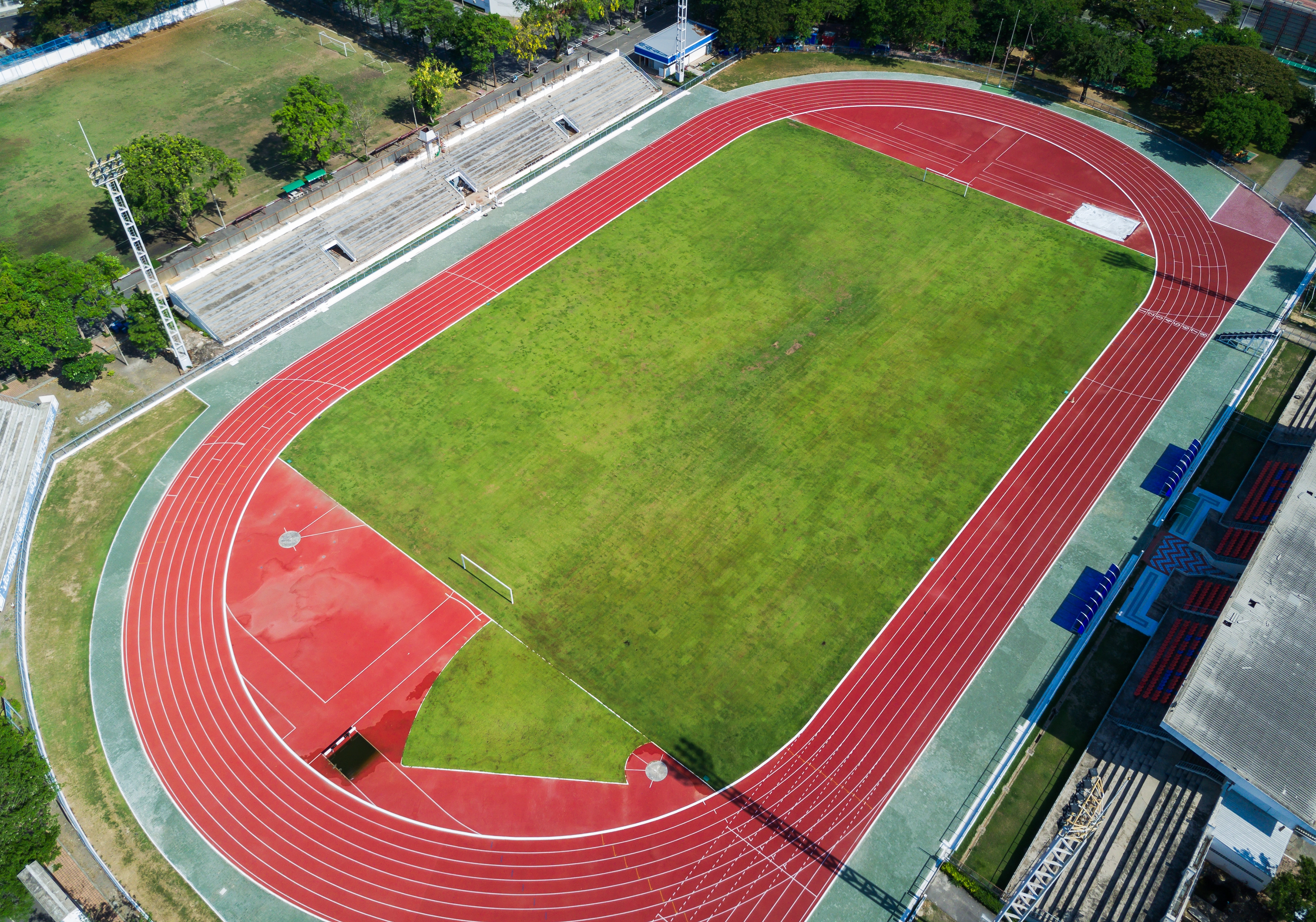
400m Running Track Dimensions Standards, Layout and Space Requirements
A standard 400m running track is not merely an oval with a 400m perimeter. It has straight, curves, no of lanes with specific widths, kerbs, measurement lines, markings, and gradients. For Athletic compliance, everything should have been accurately designed to meet the criteria.
For facilities intended for competitive use, World Athletics provides the technical rules and facilities guidance used to establish standard track geometry. The latest rules for running tracks field set the 400m standard oval. However, this track and field facilities guide provides the detailed setting-out dimensions.
If you're planning a school, sports club, stadium or community facility, understanding these dimensions is essential before construction begins.
What Are the Standard 400m Running Track Dimensions?
A World Athletics standard 400m track consists of two parallel straights and two equal-radius bends. The key dimensions are:
|
Specification |
Standard Dimension |
|
Length of each straight |
84.390m |
|
Construction radius of bends |
36.500m |
|
Lane 1 running-line radius |
36.800m |
|
Lane width |
1.22m ± 0.01m |
|
Lane marking width |
50mm |
|
Lane 1 nominal running distance |
400.0012m |
|
Inside construction-line distance |
398.1163m |
|
Standard 8-lane setting-out dimensions |
176.910m × 92.520m |
The 400m distance is measured along the nominal running line of lane 1, not directly along the inside edge. This is why the inside construction line is shorter than 400m.
How Is a 400m Track Designed?
The standard layout uses two 84.390m straights connected by two semicircular bends. The construction radius of each bend is 36.500m, including the raised inside kerb.
For lane 1, the nominal measurement line is 0.30m outside the raised kerb, giving a radius of 36.800m.
The basic calculation is:
Two straights:
84.390m × 2 = 168.780m
Two bends at the lane 1 running line:
2 × π × 36.800m ≈ 231.221m
Total:
Approximately 400.001m
This precise geometry is what makes the track suitable for accurately measured 400m races.
What Is the Lane Width on a Standard 400m Track?
Current World Athletics rules specify that each lane must be 1.22m ± 0.01m wide, including the 50mm lane line on the outside. All lanes should have the same nominal width.
This dimension is important because lane width affects the radius of each lane around the bends. Even small inconsistencies can affect race distances and starting staggers.
Older tracks constructed before 1 January 2004 may have lanes up to 1.25m wide. However, when those tracks are resurfaced, they must be remarked to the current 1.22m specification.
For a new facility, using the current standard from the design stage avoids expensive corrections later.
How Many Lanes Does a 400m Track Have?
A standard 400m track can have 8, 6 or occasionally 4 lanes. World Athletics notes that four lanes are not used for international running competition.
An eight-lane track is the practical choice for facilities intended for major competitive use. It also provides greater flexibility for schools, universities, athletics clubs and multi-sport venues.
The number of lanes should therefore be decided according to the facility's intended use, available site area and competition requirements.
How Much Space Does an 8-Lane 400m Track Need?
The standard eight-lane track setting-out dimensions are approximately:
176.910m × 92.520m
This is the basic track arrangement. It should not be interpreted as the total land requirement for a complete sports facility.
Additional space may be required for:
· Safety zones
· Field-event facilities
· Infield sports
· Spectator seating
· Athlete circulation
· Officials' areas
· Emergency access
· Maintenance access
· Drainage
· Fencing
· Lighting infrastructure
Therefore, the site should be planned around the complete facility rather than the oval alone.
What Space Is Needed Inside a 400m Running Track?
The infield of a 400m running track can be designed to accommodate athletics field-event facilities, depending on the purpose and competition level of the facility.
Possible facilities include:
· Long jump and triple jump runways
· High jump area
· Pole vault runway and landing area
· Shot put circle and landing sector
· Discus circle and landing sector
· Javelin runway and landing sector
These facilities require their own runways, landing areas, sectors and safety clearances. They should therefore be considered during the initial track layout and site planning, rather than added after the running track has been designed.
What Are the Safety Space Requirements?
The track itself is only one part of the usable facility.
The World Athletics Facilities Manual specifies an inside safety zone of at least 1.00m and recommends an outside obstacle-free zone of at least 1.00m.
These clear areas help separate athletes from obstacles and surrounding facilities.
A complete site plan may need additional space for:
· Spectator circulation
· Barriers and fencing
· Emergency routes
· Maintenance vehicles
· Field-event landing areas
· Sports equipment
· Technical facilities
For this reason, a project should never calculate its land requirement by adding only the 176.910m × 92.520m track dimensions.
What Are the Gradient Requirements?
Correct levels are just as important as correct dimensions.
World Athletics requires the kerb of the 400m standard track to be laid horizontally, while applicable gradient limits govern the running surface.
The current Technical Rules specify that lateral inclination toward the inside edge should not exceed 1:100 (1%). The overall downward inclination in the running direction should not exceed 1:1000 (0.1%) between any start and finish line, subject to the applicable rules.
These limits help maintain consistent running conditions and accurate competition measurements.
How Is a 400m Track Measured?
The inside kerb is not the measurement line for lane 1.
The lane 1 running line is located 0.30m outside the raised kerb. This produces the 36.800m running-line radius and the nominal 400.0012m track length.
World Athletics also specifies a 28-point control measurement for checking the dimensional accuracy of a standard track. The straight sections are checked against 84.390m ± 0.005m, while the bend measurements use 36.500m ± 0.005m control values.
The calculated track length after the specified equalization must be between 400.000m and 400.040m.
This demonstrates why professional surveying is critical during track construction.
Why Are 400m Starting Positions Staggered?
In a 400m race, athletes remain in their assigned lanes. Runners in the outside lanes travel around larger-radius curves than those in the inside lanes.
If every runner started from the same line, athletes in the outer lanes would run farther.
The starting positions are therefore staggered to compensate for the additional distance created by the larger lane radius.
Accurate lane width and bend geometry are essential because they directly affect these staggered starting positions.
What Are the Track Marking Requirements?
Track markings must be accurately positioned according to the applicable World Athletics marking plan.
The current rules specify 50mm-wide lane lines, while the official World Athletics technical information library provides a dedicated 400m Standard Track Marking Plan.
Correct marking is necessary for:
· Start lines
· Finish lines
· Lane lines
· Relay exchange zones
· Hurdle markings
· Steeplechase markings
· Other event-specific markings
Painting lines approximately by eye is not sufficient for a competition-standard facility.
400m Running Track Construction Checklist
Before construction begins, verify:
· Geometry: Two 84.390m straights and 36.500m bend radius.
· Lane width: 1.22m ± 0.01m.
· Running line: Lane 1 measured 0.30m outside the raised kerb.
· Track length: Meets the applicable World Athletics tolerance.
· Safety zones: Adequate clear space around the track.
· Infield: Compatible with football and intended field events.
· Gradients: Within applicable World Athletics limits.
· Drainage: Properly integrated into the track design.
· Markings: Based on the official marking plan.
· Surveying: Track geometry checked with accurate control measurements.
For a professionally constructed running surface, Forsan Alamal Alsarea's running track service offers polyurethane and EPDM track systems, including full-PU and sandwich systems, EPDM top layers and IAAF-spec line marking.
Conclusion
The 400m running track dimensions used for a standard World Athletics oval are precisely engineered. The layout uses 84.390m straights, 36.500m bend construction radii and 1.22m ± 0.01m lanes. Lane 1 is measured along a 36.800m running line, producing a nominal distance of approximately 400.0012m.
The standard eight-lane setting-out envelope is approximately 176.910m × 92.520m, but the total project site needs additional room for safety areas, field events, infield sports, circulation, drainage and supporting infrastructure.
Key Takeaways
· 400m tracks require precise geometry, not simply a 400m oval.
· Lane width, bend radius, running line and gradients must be accurately controlled.
· The complete facility requires more space than the track envelope alone.
If you're planning a new athletics facility or resurfacing an existing track, professional surveying, compliant materials and accurate installation are essential for achieving a durable, competition-ready result. Explore Forsan Alamal Alsarea's running track solutions
FAQs About 400m Running Track Dimensions
What are the standard 400m running track dimensions?
A World Athletics standard 400m track has two 84.390m straights and two semicircular bends with a 36.500m construction radius. Lane 1 has a 36.800m running-line radius and a nominal running distance of approximately 400.0012m.
How wide is a standard 400m track lane?
A current standard lane is 1.22m ± 0.01m wide, including the 50mm lane line on the outside. All lanes should have the same nominal width.
How much space is needed for an eight-lane 400m track?
The standard eight-lane track setting-out dimensions are approximately 176.910m × 92.520m. The complete site needs additional space for safety zones, infield facilities, field events, circulation and supporting infrastructure.
Is the inside edge of a standard 400m track exactly 400m?
No. The inside construction line is approximately 398.1163m. The 400m distance is measured along the lane 1 nominal running line, producing approximately 400.0012m.